None other than Gluskin Sheff’s Dave Rosenberg, the widely followed analyst who was been consistently bearish in the current market cycle, said last week that high-yield (HY) bonds are “a good place to be right now.” Recent price declines have made them attractive in the short term, and their risk-adjusted returns make them attractive to longer-term strategic investors.
From 1978 through 2010, HY bonds delivered an average annual return of 11.1% with volatility of 15.3%, comparable to the volatility of the S&P 500 (15.5%). The HY sector provides the best features of both equities and bonds: substantial long-term average annual returns combined with bond-like performance in periods when bonds dominate. Vanguard’s long-running HY bond fund (VWEHX, expense ratio = 0.25%), has delivered annual returns of 6.2% over the past 10 years, while the U.S. aggregate bond index, in contrast, has delivered 5.8% and VWEHX has current yield above 7%.
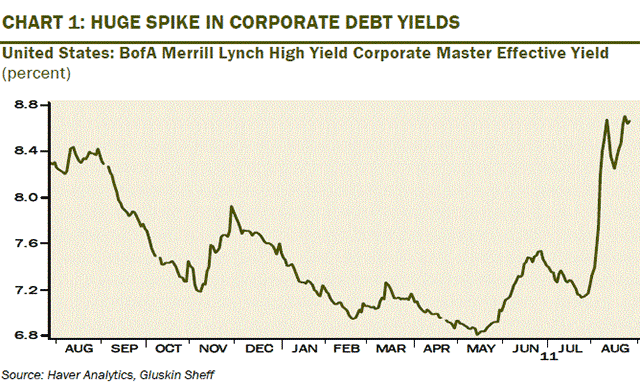
Illustrating the opportunity created by short-term price declines, Rosenberg published the following on August 29:

Corporate bonds rated below investment grade are considered high yield. These bonds are considered riskier because the ratings agencies project they are more likely to default and, if they do, their recovery rates will be lower than those of investment-grade bonds.
High-yield bonds have an interesting history that is popularly associated with scandal (e.g., Mike Milken). Many investors assume these bonds are risky and speculative, but the long-term data now available for this asset class suggest otherwise. The market for HY debt has grown dramatically in the last 20 years, from $150 billion in 1990 to over $1 trillion in 2010. In addition, the emergence of the options markets for HY bond ETFs provides greatly increased transparency. HY bonds are risky, but the risk levels are well within the range of other asset classes used in asset allocations for individual investors.
Many investors do not understand HY bonds well, unfortunately. I will explore key features of the HY bond market and why HY bonds are an important asset class for strategic asset allocation.
High-yield bonds offer attractive risk-adjusted returns
A central paradigm driving the bond markets is that yield is a proxy for risk. Bonds that are riskier will need to pay higher yields to entice investors to bear that risk. There are two primary sources of risk for bondholders. The first source of risk is interest rate risk. For bondholders, increased rates reduce the future value of the repayments they will receive from the issuer. The second source of risk is default risk, the risk that the issuer cannot make the payments on its debt.
While most investors consider yield to be an indicator of risk, the emergence of options on ETFs allows for a direct measurement of risk. This development, which occurred over the last four years, marks a major shift for advisors and investors. It used to be difficult to assess the risk levels associated with a class of bonds. For individual bonds, one could look at the ratings. For a portfolio of bonds (in the form of a mutual fund, for example), one could look at the range of ratings of bonds held in the portfolio. Conversely, one could look at the trailing historical volatility of the total returns from a bond fund. Both of these approaches had value, but neither provided a direct measure of forward-looking risk.
Today, options trade on several HY bond ETFs, and their prices provide a direct measure of portfolio risk for those ETFs. This risk measure — implied volatility — can be found, for example, at Morningstar.
The more expensive it is to purchase downside protection on an ETF in the form of a put option, the higher the implied volatility and the riskier the fund. The market’s consensus view of risk is incredibly valuable for investors. It allows them to directly compare the yields on various classes of bonds to their risk levels as captured by options prices.
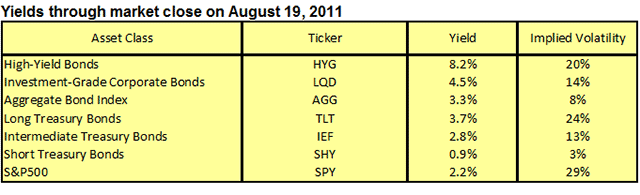
The various classes of bonds (plus the S&P 500) — as represented by their ETFs — and the yields on these ETFs make it quite clear why there is so much attention on HY today.
The ETF HYG, which tracks the iBoxx Liquid High Yield Index, has $8.9 billion in assets and holds 475 bonds. It is yielding 8.2%, which is 450 basis points above long-duration Treasury bonds and 370 basis points above investment-grade corporate bonds. In the current very low-yield environment, it is little wonder that HY bonds are of interest.
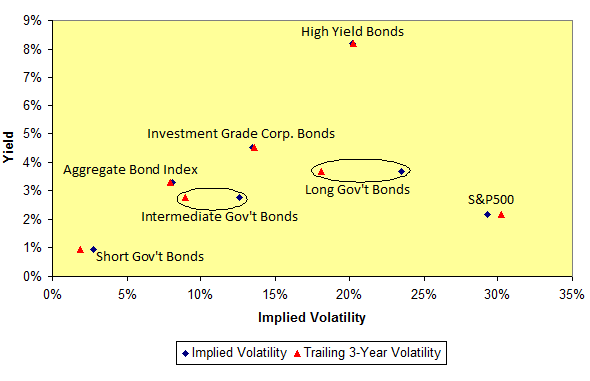
In theory, the higher yields provided by HY bonds are offset by a proportionate increase in risk. When we look at yield versus implied and historical volatility, this is not the case, however. HY bonds are providing considerably higher yield than long-term Treasury bonds with less downside risk. This inconsistency in the pricing of yield versus total risk is more extreme today than in the past couple of years.
The risks associated with Treasury and high-yield bonds are very different, however. With Treasury bonds, there is essentially zero risk of default, so all of the risk is interest rate risk. Indeed, the return on IEF (which holds mostly 7-10 year Treasury bonds) has a -98% correlation to the CBOE 10-year Treasury Yield index. Similarly, TLT has a -95% correlation to the 10-year Treasury Yield index. By contrast, the returns on HYG have a +2% correlation to the CBOE 10-year Treasury Yield index.
In other words, while variability in interest rates explains almost 100% of the return from the Treasury bond funds, almost no correlation exists between changes in rates and the return on HY bonds. This means that the returns on HY bonds are entirely a function of default risk. By contrast, investment-grade bonds (LQD) have a mix of interest-rate risk and default risk. LQD has a -49% correlation to the CBOE 10-year Treasury Yield index, so a considerable portion of its return is explained by default risk.
As I recently wrote, high-yield bonds are attractively priced based on current yield and implied volatility. This is especially striking in today’s prices. Fairly optimistic assumptions about earnings growth rates indicate that U.S. stocks will return 8% or so per year on average over the long term. With HY bonds, you can get an 8% yield today with option implied volatility that is two-thirds that of the S&P 500. On this basis, HY bonds are considerably more attractive than U.S. stocks and provide more yield than long Treasury bonds with similar implied volatility.
Yield vs. Risk (based on implied volatility for March 2012 options)
I included trailing three-year and implied volatility in the graph above for each ETF. Implied volatility (as of August 19, 2011) matches the trailing three-year volatility (using data through July 2011) very closely for most bond classes, although the implied volatilities for intermediate-and long-term bond ETFs are notably higher than their historical volatility levels. While the financial media has focused on a flight to safety in which investors have driven yields downwards by investing in the safest asset classes, the options markets are telling us that the Treasury bonds market has recently become notably riskier.
I used options expiring in March 2012 because these are the longest dated options available for HYG.
Default and recovery rate risks are low
The leading authority on the HY market is Edward Altman at the NYU-Stern School of Business. On Feb. 4, 2011, Altman’s group at NYU published a the latest installment of their annual report titled Defaults and Returns in the High-Yield Bond and Distressed Debt Market: The Year 2010 in Review and Outlook.
Altman’s work allows us to answer two obvious questions with regard to HY bonds. First, because HY bonds are yielding below their historical average over the past 30 years, one might question whether investors are getting too little reward for holding these risky bonds. Altman provided historical data on the yields of HY bonds and 10-year Treasury bonds going back to 1978. He also looked at the spread between HY and 10-year Treasury bonds as a measure of the risk premium that HY bonds provide. While the total yield on HY is low historically, the spread between HY and Treasury bonds is currently above its average from 1978 through 2010. The yield to maturity for HYG is 8.2%, while the YTM for 10-year Treasuries is 2.1%. The difference in yield, 610 basis points, is greater than the historical average yield spread of 5.22% reported by Altman.
The second question that arises with HY bonds is whether the level of default and expected recovery risk are increasing. Altman specializes in predicting the likelihood of corporate distress and default, and he addressed the problem of predicting default and recovery. First, he presented data that showed that one can predict recovery rates using default rates. He then combined three methods for predicting 2011 default rates and came up with an average forecast of 3.2% and recovery rate of 39.8%. This predicted default rate is below the historical annual average of 3.3% for HY bonds between 1971 and 2010, based on Altman’s data.
In the context of Altman’s 30+ years of data on HY bonds, the current yield spread is just slightly above average, the expected default rate is slightly below average and the expected recovery rate is slightly above average. There is no reason to believe that HY bonds are overvalued.
Given that the yield on HY bonds is disproportionately high relative to their current risk level, we can now apply Altman’s research to explore how high default rates need to be before HY bonds have the same yield versus risk of other fixed income classes and become unattractive. Using Altman’s data, the default rate must increase to 4.2% to bring HY bonds in line with other bonds. A 6.2% default rate would bring the effective yield of HY bonds down to that of long Treasury bonds. Even at a 4.2% default rate, HY bonds will be attractive to investors with the appropriate risk tolerance. For 2010, the default rate of HY bonds was 1.13%, but in 2009 the default rate was 10.8%, and in 2008 it was 4.65%. Prior to 2009, the last year with a default rate at 6.2% or above was 2002.
Conclusions
HY bonds have a 30+ year history of higher annual returns and lower risk levels compared to equity indexes. In addition, they are essentially uncorrelated to interest rates and provide a high level of income. Altman’s research shows that HY bonds do not face inordinately high default or recovery-rate risk. Options on HY bond ETFs provide forward-looking risk estimates showing that HY bonds are attractively priced.
Indeed, HY bonds may have already discounted economic risks that the equity markets have not. As Gluskin’s Rosenberg noted last week, there is a 60% chance of recession already embedded in HY prices, whereas the equity markets imply only a 30%-50% chance of recession.
Despite these attractions, HY bonds do not have a great deal of exposure in popular asset allocations. The growth in HY research and the increased transparency in risk levels (through ETF options) should encourage advisors to integrate HY bonds into their portfolios. Particularly as a large portion of the U.S. population is moving from the accumulation stage of their lives into the income-drawing stage, HY bonds deserve more attention.
Geoff Considine is founder of Quantext and the developer of Quantext Portfolio Planner, a portfolio management tool. More information is available at www.quantext.com.
Geoff’s firm, Quantext is a strategic adviser to FOLIOfn,Inc. (www.foliofn.com), an innovative brokerage firm specializing in offering and trading portfolios for advisors and individual investors
Read more articles by Geoff Considine, Ph.D.