Seven lean years
Followers of Jeremy Grantham know his consistently accurate long-term forecasts well, as well as his ability to identify and avoid asset bubbles and steer clients into high-performing asset classes. His January 2010 letter to investors attests to his record and offers his latest forecast for the next seven years – his standard prediction time horizon.
Grantham’s prescience is remarkable but not irreplicable. My own Monte Carlo simulations at the end of 2008 produced projections nearly identical to his at the time, and my simulations today nearly match Grantham’s current forecasts.
Given the commonalities between Grantham’s outlook and my own, I used Monte Carlo simulations to examine his forecast for a critical component of his asset allocation – US “high-quality” stocks – and to show how incorporate them into one’s own allocation. Moreover, I show that “dividend aristocrats” and low-beta stocks are an attractive universe from which to select high-quality stocks.
Increasing allocations to those high-quality stocks should lead to improved performance without sacrificing additional risk.
Grantham’s current prediction, which he discusses at length in his most recent letter, is for “seven lean years” – a period of depressed returns across nearly all asset classes. He projects large-cap U.S. equities to return just 1.3% per year. Worse still are small-cap U.S. equities, from which he expects only 0.5% annual returns. International developed market equities fare better (4.7%) in this scenario, but emerging markets equities look relatively anemic (3.9%).
Fixed income looks equally daunting. US government bonds are projected to return about 1.1%, and TIPS are projected to return only 0.8% per year.
The only equity asset class that looks attractive to Grantham is US high-quality stocks, for which he projects a return of 6.8%.
Grantham’s forecasts are real returns; they do not include his projected 2.5% annual inflation rate.
Grantham by way of Monte Carlo
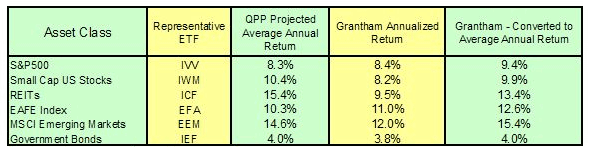
Using my Quantext Portfolio Planner (QPP) software, I analyzed the asset class projections Grantham made at the end of 2008. To compare QPP and Grantham, I converted Grantham’s compounded annual growth rate (CAGR) returns into arithmetic average annual returns. I obtained the following, using QPP’s baseline settings (3% inflation, 8.3% per year arithmetic annual return and 15.1% annualized volatility for the S&P 500):
Projections from December 2008 Comparison (table taken from original article)

The consistency between the third and fifth data columns was the first evidence that QPP and Grantham yielded remarkably similar outlooks.
At that time, both Grantham and QPP were projecting US high-quality stocks to be substantial out-performers.
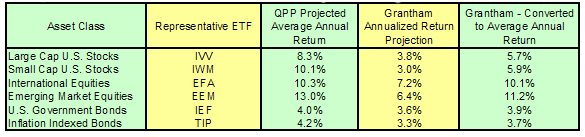
In February of this year, I again compared Grantham to QPP using all baseline settings in the Monte Carlo and three years of historical data through 2009 to initialize the model. The results are shown below. The trailing historical volatility of the ETFs is used to convert between CAGR (annualized return) and arithmetic average annual return.
Comparison between QPP and Grantham (Feb 2010)
Again, the Monte Carlo projections for average annual return that QPP generates are very close to Grantham’s for a number of major asset classes. To make the numbers comparable, I have added Grantham’s expected inflation of 2.5% to his expected real returns and converted his annualized returns (CAGR) into average annual returns using the following equation:
(1+Avg. Annual Return)2 - (Annualized Volatility)2 = (1+CAGR)2
To convert from CAGR to average annual return, I used the trailing three-year volatility for each of the representative ETFs.
Grantham is projecting average annual returns of 3.9% for US Government bonds and 3.7% for inflation indexed bonds, whereas QPP expects those to yield 4.0% and 4.2%, respectively. These projections are remarkably close. For international developed equities, Grantham expects no meaningful difference between large and small cap, and he believes that the category as a whole will have average annual returns of 10.1%. The Monte Carlo projections project an average annual return of 10.3% per year for international developed market equities.
For emerging markets, the asset class where Grantham expects the highest returns, Grantham’s projects 11.2% in average annual return. The Monte Carlo simulation yields a similar outlook, projecting 13% per year.
Grantham believes that emerging market stocks are overpriced, which lowers his estimates. Emerging markets were the outperforming asset class over recent years, so his point is well taken. The uncertainty in estimates of future return are a function of the volatility in that asset class, and the annualized volatility of EEM, my proxy for emerging markets, is 32.4% per year over the three years through 2009. Volatility that high is sufficient to explain the differences between my Monte Carlo projections and Grantham’s.
Up to this point, we have seen remarkable consistency between my Monte Carlo projections for various asset classes and Grantham’s projections. One area, though, exhibits substantial differences: broad market-cap weighted domestic equity indexes. Grantham’s projections reflect his belief that these indexes are greatly over-valued. The Monte Carlo’s baseline projection for the S&P500 is 8.3% per year, whereas Grantham projects 5.7% from large cap domestic equities. A similar disparity exists for small-cap stocks.
Looking for quality
US high-quality stocks, on the other hand, are the relative bright spot in Grantham’s seven-year outlook. Examples of companies that he places into this category are Johnson and Johnson (JNJ), Coke (KO), Procter and Gamble (PG), Wal-Mart (WMT) and Microsoft (MSFT).
Grantham predicts that this asset class will return 6.8% annually in real terms – 9.3% nominally. Such predicted out-performance stands in stark contrast to market-capitalization-weighted US equities and even well above emerging market equities.
A portfolio with 20% weighted to each of Grantham’s sample high-quality stocks (JNJ, KO, PG, WMT, MSFT), using the same projection of performance (baseline settings and initialized with three years of data through 2009), produces in QPP a projected average annual return of 8.5% with a volatility of 13%. Using this volatility value as a proxy for high-quality stocks in general, I then convert to Grantham’s annualized return value to an arithmetic average annual return, which comes out to 10.1% per year for high-quality stocks.
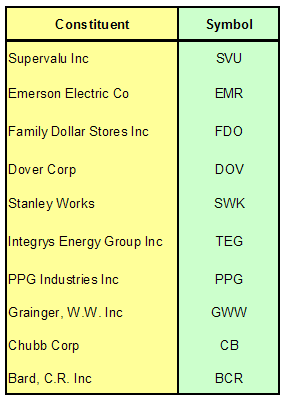
A major question is how one classifies high-quality stocks. Grantham provided a set of blue-chip stocks as examples, but that clearly falls short of a precise definition of this asset category. The stocks Grantham proposed are stable, well-run companies that are somewhat insulated from market upheavals. Many such companies can be found among the so-called “dividend aristocrats” (firms that have maintained or raised dividends every quarter for the past twenty five years), and my Monte Carlo simulations have consistently projected above-average returns for portfolios of those stocks. The top ten dividend aristocrats by market cap as of this writing are:
Top Ten Dividend Aristocrats by Market Cap
For a portfolio equally weighted among these stocks, QPP produces a projected average annual return of 11.9% with annualized volatility of 17.5%. Converting to CAGR, this portfolio returns 10.5% – quite close to and even slightly higher than Grantham’s 9.3% projection for his high-quality stocks. The portfolio of these ten stocks is riskier than the S&P500, however. It’s also riskier than an equal-weighted portfolio of the high quality stocks suggested by Grantham.
In an analysis of a portfolio of dividend aristocrats I conducted in March 2007 and again in April 2009, my Monte Carlo projections suggested that a portfolio made of stocks from this group would substantially outperform the broader U.S. market and developed international markets. When I re-ran QPP in February 2010 with the same portfolio of aristocrats from my April 2009 analysis, I once again found expected returns well exceeding the S&P500’s (12.7%), albeit with higher volatility (16.5%). That’s consistent with the analysis in the previous section. The population of aristocrats changes with time, so the consistency between a portfolio of current aristocrats and a portfolio from an older listing reinforces the validity of this approach.
Bringing the pieces together
A little over a year ago, Grantham projected annualized returns for equities and a range of other risky asset classes that looked very good indeed – which matched my Monte Carlo projections very closely. Today the outlook is far less rosy, largely because of the massive rally in equities in 2009. Grantham believes that the broad domestic stock indexes are simply too expensive on the basis of reasonable future earnings and earnings growth. At the same time, however, there remain some great opportunities in US high-quality companies.
“For the longer term, the outperformance of high quality U.S. blue chips compared with the rest of U.S. stocks is, in my opinion, ‘nearly certain,’” he wrote in his letter to investors, explaining that he defines ‘nearly certain’ as more than a 90% probability.
While Grantham‘s forecast for domestic stock indexes are notably worse than those of Monte Carlo’s long-term baseline, this difference affects little which asset classes qualify as attractive. US high-quality stocks look good. Emerging markets, unsurprisingly, are a high-return/high-risk proposition, and are even riskier today than at the time of Grantham’s writing because of high prices.
Grantham’s outlook is fairly consistent with PIMCO’s “New Normal” world view in its implications for equity exposure. High-quality stocks also tend to be consistent dividend payers, and dividends are likely to make up a larger fraction of total returns in a “New Normal” world. International stocks look more attractive than domestic equities – something reflected in the projections for EFA versus SPY.
Low-beta equities also look more attractive in a New Normal scenario, and the dividend aristocrats tend to have low betas. The beta for an equal-weighted portfolio of the top ten aristocrats by market cap is 0.87, which is fairly low for an all-equity portfolio. One piece of Grantham’s outlook that is inconsistent with the New Normal, which includes the possibility of substantial inflationary pressures, is his low expected inflation rate of 2.5%. In the event of higher inflation, inflation-indexed bonds will substantially outperform nominal bonds, and real assets, such as timber, will look more attractive.
A brief note on timber
Aside from high-quality stocks, Grantham’s projections identify one other possible source of outperformance: He projects 6% in real return (8.5% in nominal return) for managed timber. A portfolio allocated equally to each of two large timber REITs, PCL and RYN, has a projected average annual return of 12.7% in QPP. When I convert Grantham’s 8.5% CAGR to average annual return (using the projected volatility for my timber proxy), I get average annual return of 11.1%. Once again, the results are quite close.
Conclusions
When I first compared my Monte Carlo simulations to Grantham’s outlook in 2008, I was surprised and, frankly, gratified by their similarity. I had the same reaction this time around. Grantham has a remarkable track record, so I’d rather be betting with him than against him.
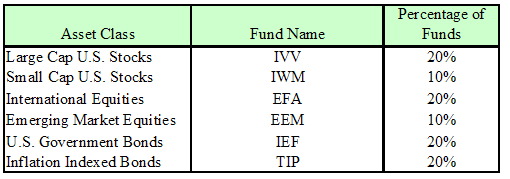
Our shared outlook calls for a substantial shift away from traditional asset allocation models. To demonstrate this, we will start with a reference case from QPP for a fairly generic 60/40 portfolio:
QPP projects an annual return of 7.7% for this portfolio, with annualized volatility (standard deviation in returns) of 12%. Recall that QPP has higher estimates than Grantham of the expected returns for domestic equities as a whole. If I adjust QPP’s projections for large-cap and small-cap domestic equity indexes downward to agree with Grantham, the projected total portfolio return drops to 6.7%.
If I alter the portfolio such that the bond allocations remain the same, but the equity allocation is 20% to EEM and 4% each to the top ten dividend aristocrats (listed previously), my new 60/40 portfolio will have expected average annual return of 9%, with annualized volatility of 11.9% (almost identical to the volatility of the original 60/40).
If we believe Grantham’s more dire projections for broad-based U.S. equities, focusing the equity portion of the portfolio on high-quality domestic equities and foreign equities adds 2.3% per year in expected return over a typical 60/40 allocation. If we use QPP’s baseline projections, this is a more modest 1.3% benefit. Either way, such a shift substantially boosts expected return without adding portfolio risk.
The conceptual implications of this kind of departure from standard asset allocations are huge. Can markets really be so inefficient that the market-cap-weighted equity indexes impose a substantial net drag on overall performance? Ten years ago, this would have seemed outlandishly unthinkable. Today, it seems a lot more plausible.
Quantext Portfolio Planner is a portfolio management tool. Extensive case studies, as well as access to a free extended trial, are available at http://www.quantext.com
Quantext is a strategic adviser to FOLIOfn,Inc. (www.foliofn.com), an innovative brokerage firm specializing in offering and trading portfolios for advisors and individual investors.
Read more articles by Geoff Considine, Ph.D.