Advisor Perspectives welcomes guest contributions. The views presented here do not necessarily represent those of Advisor Perspectives.

Leave it to an active activist to play a shell game in proposing a bet that cannot be won by his challengers. Your recent article by Roger J. Schreiner, The $100,000 Challenge to Passive Managers, challenged John Bogle to a wager and Schreiner claims that if Bogle doesn’t accept the bet, it will “prove my point- that my active investment process is superior to his high-risk ’buy and hope’ approach.”
If Bogle wisely doesn’t take Schreiner’s bet, all it will prove is that Bogle is better at math than Schreiner. A passive investor cannot win the bet based on the rules Schreiner outlined. You see, to beat Schreiner in his shell game and to make people think they can win at his casino table, the passive portfolio must produce BOTH a higher return AND lower DAILY standard deviation. Let’s examine how this might play out and see how Schreiner’s rules enable him to make sure he wins.
Say I’m John Bogle and I don’t bother thinking about how Schreiner stacked the deck with his rules and take him up on his challenge. To make my portfolio selection easy I just copy the Wealthcare Capital Management “Growth” Portfolio which is allocated as follows:
77% Total Domestic Equities (R3000, MS Total Domestic or W5000)
13% Foreign Equities (EAFE or World Ex-US)
10% Fixed Income (7-10 Year Treasuries)
I find it ironic that the same day I read Schreiner’s article I was notified by the Informa PSN Manager Database that this simple indexed portfolio was a “Top Gun Manager of the Decade” for their “All Cap Core Equity Universe.” That should be good enough for Bogle.
So, Schreiner is faced with the daunting task of creating a portfolio that will EITHER produce higher Total Return OR less risk to beat Bogle on his Wealthcare Capital Management passive portfolio. Think about this. Bogle needs to create a portfolio that has to produce higher return AND lower daily standard deviation to beat Schreiner, but Schreiner beats Bogle if his returns are lower as long as his risk is lower too. Or, if Schreiner produces higher return with higher daily standard deviation, Schreiner wins.
To beat Schreiner you have to produce both; for him to win he only has to produce one or the other. Wait second…that is easy. If I’m Schreiner and I just put the whole portfolio in cash I will produce less daily standard deviation and I win. That is a guaranteed winner. There is no doubt about it. Shazaam…active management genius!
Now, realistically Schreiner would be publicly flogged if he just left all his guaranteed winning portfolios in cash. So to give the appearance of not just exploiting the stacked deck of a bet no passive manager could win, he participates in the markets. He doesn’t need any timing or skill to make sure he wins the bet. Schreiner could just copy the Wealthcare Growth Portfolio that Bogle chose in the same proportion, except he will hold 5% cash. That is a guaranteed winner too because his daily standard deviation will be lower. Other choices for Schreiner to win would be to replicate the portfolio exactly for most of the time, but use cash in the last month, which with the rule he chose of daily standard deviation will guarantee Schreiner a win once again regardless of what the returns are in the last month. If the markets decline in the last month, he will end up with higher return AND less risk and he will be able to claim he is a skillful market timer and “controls risk” with his active strategy. If the markets go up the last month, he will have a lower return but will win because he will still have less daily standard deviation. How naïve does Schreiner think passive managers are? Who would be dumb enough to take this sucker bet?
If Schreiner is so confident in his “skill” (I have to admit he is skillful at shell games as most active activists are), why not reverse the rules and see if he is willing to bet that his active portfolio will produce BOTH higher returns AND less risk like he requires of passive managers in the bet against him? Are you up for that? At least that would be a fairer bet because the passive portfolio is restricted from playing the games that Schreiner could use to guarantee a win. Does the passive portfolio get to rebalance? According to the rules of his shell game, it appeared that they do not. I’m not aware of any passive managers that argue for never rebalancing.
In 2008, I invited Warren Buffett to a $2 Million Charity Investment Challenge (along with 19 other active activists) when I was writing Stop the Investing Rip-off. It is mentioned in the beginning of the book and was published last spring by John Wiley & Sons. The original letter I sent to Buffett is available here.
The problem with all of those that have copied the original Buffett bet that he made with Protégé Partners (Buffett bet on an index fund by the way) is that they focus on percentage returns. Higher percentage returns may not necessarily produce more dollars of wealth. In Schreiner’s case, he added risk, but lower risk doesn’t necessarily mean more dollars of wealth, despite a higher return.
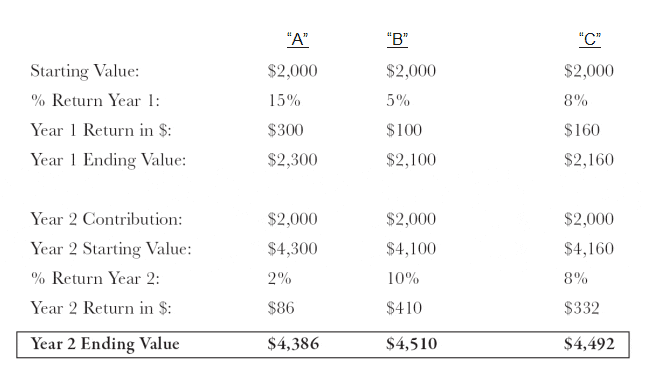
Here’s a simple example of how a higher return, or a higher return with less risk can end up producing less dollars of wealth for an investor that is saving $2,000 a year.
| 2 Year Compound Return |
Risk (SD) |
$ Profit |
| A |
8.30% |
9.19% |
$386 |
| B |
7.47% |
3.53% |
$510 |
| C |
8.00% |
0.00% |
$492 |
This is timing risk and it is why active activists measure themselves using time-weighted returns instead of dollar weighted-returns because they cannot control WHEN they will outperform for any particular client which is what is needed to actually produce more wealth (luck sometimes works too).
If we are going to call ourselves wealth managers (see: Measuring Temperature with a Ruler – Is Your Wealth Manager Really a Return Manager in Disguise?) it is time we stop playing this misleading statistical game that deceives investors into thinking that higher returns or lower standard deviations will necessarily have a monetary benefit. They could, but they might not. Try spending a percentage return or low standard deviation at a grocery store if it is NOT backed up by dollars of wealth!
So, in my $2 Million Charity Challenge, I reject the idea of just one lump sum being invested with no contributions or withdrawals (how many of your clients neither save nor spend money?) and measuring things on statistics that do not necessarily equal dollars of wealth. Instead, how about we make a bet that is more realistic to real people and measure it in dollars rather than potentially misleading statistics?
I challenge twenty active (or passive or pseudo-passive) managers to put up $100,000 each in the form of ten years of annual $10,000 contributions deposited to the account the first business day of each calendar year starting January 2, 2011. Isn’t this more like a real client? Don’t you have some clients that are accumulating wealth? At the end, we simply measure the dollars in the account…no misleading statistics that can’t be spent!
Any active manager whose account value after a decade (measured as the portfolio value on December 31, 2020 net of all costs) beats the dollars in our net-of-fee Growth Portfolio (available to any of our 401(k) plan participants) wins and they choose the charity for their account value and we kick in an extra $10,000. If their account (or whatever is left of it) is less than our account value, we get to pick the charity.
While I didn’t invite Schreiner in my original bet, he and any others who wish to take this challenge on are welcome to join in. I know some will beat us, but I know many will not. The odds are in my favor because we aren’t taking non-systematic risk and are likely to have far lower expenses. Just like the tables in Las Vegas, some will win against us despite the odds being against them. But that doesn’t mean that gambling in Vegas is a winning bet. So, in reality, like Schreiner and even more like the tables in Vegas, my deck is stacked against my challengers too. The funny thing about that is that my challengers won’t admit they are making a bet against a stacked deck, even though I’m telling them they are up front (unlike Schreiner). But, at least it is a game where challengers have a chance to win (like Vegas) and measures what matters… dollars.
The full rules of the contest are available here.
A popular industry speaker and writer, David B. Loeper is the CEO and founder of Financeware, Inc. in Richmond, VA,. He is author of the top selling book Stop the 401(k) Rip-off!, three other books being released in 2009 by John Wiley & Sons (Stop the Retirement Rip-off, Stop the Investing Rip-off and The Four Pillars of Retirement Plans) and numerous whitepapers. He has appeared on CNBC and Bloomberg TV, served on the Investment Advisory Committee of the $30 billion Virginia Retirement System, and was chairman of the Advisory Council for the Investment Management Consultants Association (IMCA). Before founding Financeware in 1999 he was Managing Director of Strategic Planning for Wheat First Union. He earned the CIMA® designation (Certified Investment Management Analyst) from Wharton Business School in 1990 in conjunction with IMCA.
Read more articles by David B. Loeper, CIMA, CIMC