Advisor Perspectives welcomes guest contributions. The views presented here do not necessarily represent those of Advisor Perspectives.

This essay is excerpted from the most recent version of the HCM Market Letter. To subscribe directly to this publication, please go here.
“I told Teddy [Forstmann] that in my mind, The Sellout was all about Wall Street and the financial system having to ‘sell out’ to survive after its three-decade binge on risk and leverage, by being bailed out first with capital coming from foreign sovereign wealth funds…and then ultimately by the federal government.
“In other words, not only had Wall Street literally had to sell out because it had embraced excessive risk taking, it had also sold out its principles: greed had become its business model, not all the factors that make Wall Street important to society, such as raising money for businesses and providing access to the stock markets to the middle class…
“Forstmann got a good chuckle out of that. ‘So what you’re saying is that somewhere along the line, Wall Street as an institution had some principles to sell out,’ he said with a laugh. ‘I am here to tell you Wall Street never had principles.”
Charles Gasparino, The Sellout (2009)
HCM recently wrote to one of its friends that our surprise prediction for 2010 is that the year will pass with nothing bad happening and everyone living happily ever after. That was written only a couple of weeks before the last Black Swan event of 2009 – some idiot setting himself on fire while trying to blow up an airliner on a flight from Amsterdam to Detroit on Christmas Day. Nonetheless, other than making air travel even more abhorrent an experience than it already is, this episode is unlikely to have any serious effect on what is likely to be the story for much of the next year – zero interest rates and continued efforts by the government to support what is ultimately unsustainable – the Ponzi-like structure of the U.S. economy. This bodes well for short-term market performance.
Accordingly, our short-term forecast is that the financial markets will rise over the first half of 2010. Our target on the S&P 500 is 1200-1250 by mid-2010. We also expect corporate credit markets to perform well. Credit spreads should continue to tighten by another 100 basis points over the first six months of the year.
We are highly aware that this forecast is in stark contrast to our prediction 15 months ago that the Dow Industrial Average was headed to 5000. While the market did drop as low as 6547 on March 9, 2009, world governments succeeded in preventing the worst from happening. And it is more likely than not that we will not see the lows of March 2009 again in our lifetimes. But it is not impossible. At some point, the markets will wake up to the ugly realities that lie below the surface of what can fairly be described as a Potemkin’s Village recovery.
For it is abundantly clear that the financial crisis has led to absolutely no alteration in thinking at the Federal Reserve, Treasury, Congress or inside the White House that would lead to a sounder path of economic policy management. With respect to every aspect of economic policy that matters, our political and business leadership is failing to come up with the proper long-term answers.
- The pending financial regulation bill lacks the necessary tools to limit the types of speculation in credit derivatives that caused so much damage in 2008 – and the only reason why is that lobbyists and their Congressional concubines hijacked the bill.
- The Obama Administration was so hell-bent on delivering healthcare reform that it allowed Congress to write a bill that reforms little but gives political horse-trading a bad name at an enormous cost to the American taxpayer. The healthcare undertaking spread the President and Congress too thin and should have been deferred to a later date.
- Congress continues to stuff spending bills with earmarks that bust the budget and make a mockery of the President’s pledge to put an end to such practices. We are facing years on end of trillion dollar deficits with absolutely no prospect of budget discipline.
Little if anything has changed on Wall Street; at best the names have been changed to protect the guilty. The major financial institutions are earning most of their money from trading, not by lending, except they are now trading under the aegis of the U.S. government’s zero interest rate policy and the implicit understanding that the government will do everything possible to protect them from failure. The charade of financial regulation that will shortly be debated in Congress should be understood as an abject surrender to the combined political and business elites that led this country to the brink of complete economic meltdown in 2008 and early 2009. There is no way to avoid reaching that point again by continuing to follow the same policies. The only question is when, not if, the next crisis will occur. That time will not come during the first half of 2010 and probably not during the second half, but at some point the United States is going to have to pay the piper for its failure of leadership. Enjoy the rally while it lasts. HCM continues to advise its readers to buy some gold every month, not for a trade, but for the time when Mad Max and his gang come knocking at the door.
The continuing GSE bailout
The most recent evidence that the U.S. is stuck on an unsustainable long-term economic path was the Christmas Eve move by the Treasury Department to extend its support of Fannie Mae and Freddie Mac. These two agencies own or guarantee about $5.5 trillion of the $11.8 trillion of outstanding U.S. mortgage debt, and financed about 75 percent of new mortgage debt in 2009.1 Realizing that the housing problem is not improving, and that these two government protectorates are still bleeding money, Treasury Secretary Timothy Geithner agreed to provide unlimited aid to Fannie and Freddie for the next three years in order to alleviate market concern that the $200 billion lifeline previously provided to the each of the two agencies would be exhausted. The Treasury also slightly relaxed the timetable for the companies to reduce their mortgage portfolios.2 The stock market, or at least the day traders that muck around in the penny stocks to which these former mortgage giants have been reduced, celebrated by rallying Fannie and Freddie by 21 percent and 27 percent, respectively, on December 28, 2009, the first trading day after the announcement. As HCM has argued before, allowing speculation in the stocks of these government-supported entities is highly inappropriate and contributes to the unhealthy culture of speculation that is responsible for so many of the excesses in the financial system.
HCM will leave it to others to determine whether it was purely coincidental that the government approved, at virtually the same time, generous pay packages for Fannie’s and Freddie’s CEOs. Coincidental or not, it seems highly inappropriate to pay millions of dollars to the heads of companies that are nothing more than government entities. Government employees are not supposed to earn millions of dollars, particularly when their departments are losing hundreds of billions of dollars. Are we the only ones who think that something is rotten in the Kingdom of Denmark?
1 Bloomberg, December 28, 2009, “Mortgage Anxieties Mean Limbo for Fannie and Freddie.”
2 Before the holiday announcement, Fannie and Freddie were required to reduce their retained mortgage holdings by 10 percent per year; now they just have to keep their portfolios below a maximum limit of $900 billion (a number that will fall 10 percent per year). Fannie’s portfolio was $771.5 billion at the end of October 2009 and Freddie’s was $761.8 billion at the end of November.
As our friend David Kotok noted, the Treasury’s action moves us one step closer to the day when the government will formally nationalize Fannie and Freddie and add their debt to the nation’s already swollen balance sheet. But the difference between the so-called “implied” guarantee and a formal guarantee at this point is a matter of form over substance – nobody believes that the U.S. government will ever walk away from these obligations. For all intents and purposes, these companies were nationalized long ago and the financial crisis just confirmed what everybody already believed. Accordingly, the latest move, designed to minimize press coverage and market disruption, fooled absolutely nobody but showed the limitations of our leaders. The U.S national debt is not $11 trillion, but $16.5 trillion and rising once Fannie and Freddie are counted.
Mr. Kotok also makes the very important point that this move adds to the necessity for the Federal Reserve to maintain low interest rates for a prolonged period of time. In 2009, the Federal Reserve bought more than $1.1 trillion of Fannie’s and Freddie’s home-loan bonds and more than $124 billion of their corporate debt in an effort to lower their funding costs. This helped push mortgage rates to a record low of 4.71 percent in December 2009. Throughout 2009, rates on a typical fixed-rate 30-year mortgage averaged 5.04 percent, down from 6.05 percent in 2008, according to weekly surveys from Freddie Mac. Mortgage rates need to stay as low as possible for the housing market to have any chance of recovery. Rates on Fannie and Freddie paper will play an important role in determining where mortgage rates settle out in 2010. The Federal Reserve will be sure to do everything in its power to keep mortgage rates low, which means that zero interest rates are here to stay for the foreseeable future.
But the rot runs even deeper at Fannie and Freddie. The government had to do even more to keep the two GSEs afloat. In order to keep Fannie and Freddie solvent, the Treasury had to purchase $191 billion of their mortgage bonds and $112 billion of their preferred stock. Why did the Treasury have to do this? Because the companies lost a combined $188.4 billion over the last nine quarters! That is even greater more money than AIG lost during this period. This is the performance for which their CEOs – who are working for the government - are being paid millions of dollars!!!!!?????
The Treasury Department’s management of the GSEs continues the disastrous Congressional creation and management of these entities. Trying to slip through the extension of aid on Christmas Eve was also amateurish at best. There was absolutely no chance that savvy market watchers would fail to factor the lifting of limits on aid to the two housing agencies into their investment and trading calculations. Moreover, the Treasury Department must be seen to be engaging in more of the same wrongheaded economic policies that caused the financial crisis in the first place, and delaying the necessary adjustments that need to occur in order to purge the economy of the excesses that are preventing it from regaining a productive growth path. To quote Marc Faber: “the ‘crisis’ is unlikely to compel economists at the Fed and the Treasury ‘to reach for a new paradigm.’ With fiscal and monetary measures they will attempt to prevent consumer prices from declining, which would actually be favorable for the economy as consumers’ purchasing power would increase…But in the process of combating consumer price declines, these economists and bureaucrats will create massive bubbles in one or another sector of the global economy, which will lead to renewed economic and financial instability sometime in the future.”3 Actually, rather than creating a new housing bubble moves like the Treasury’s are preventing the previous bubble from being effectively unwound.
Between the end of 2002 and the end of 2006, total U.S. outstanding debt increased from $31.84 trillion to $45.32 trillion, an increase of 42.3 percent. By 2006, total U.S. indebtedness equated to 350 percent of GDP.4 This rise in indebtedness coincided with a period of extremely low interest rates and brought the country to the cusp of the financial crisis. Moreover, a significant portion of this indebtedness was concentrated in the financial sector. Between the end of 2002 and the end of 2007, financial sector debt increased from $10.1 trillion to $16 trillion, reaching an unprecedented 117 percent of U.S. GDP.5 We all know what happened then (we were treated to a front row seat to Hyman Minsky’s “financial-instability hypothesis”), and what the authorities did to combat the near collapse of the system – they increased debt further to replace the trillions of debt that was wiped out. Virtually everybody considered this traditional Keynesian approach to the crisis to be the correct one because the alternative – a complete systemic collapse – was considered unthinkable. But treating a debt crisis with more debt can only delay the ultimate day of reckoning, which is one reason why assets such as gold are rising while paper assets such as the U.S. dollar and other fiat currencies are falling. The hope is that delaying the end of days will give policymakers time to design a different and far less painful endgame. In order to do that, however, they are going to have to start heeding the lessons of the past. And there is little indication that they will be able to that. But this is the beginning of a new year, so one can always hope. But while one hopes, one should also be preparing for the worst.
Bernanke the clueless
We will definitely need to prepare for the worst as long as our leaders continue to deny the obvious. In a speech on January 3, Federal Reserve Chairman Ben Bernanke argued that low interest rates did not cause the housing bubble. Instead, he argued that monetary policy after 2001 “appears to have been reasonably appropriate, at least in relation to” the so-called Taylor Rule. The Taylor Rule is named after Stanford University economist and former Treasury undersecretary John Taylor, who created a shorthand formula that outlined how a central bank should set rates if inflation or growth veers from targets. This is another example of why economic policy should not be left in the hands of professors who have little real-world experience. For Mr. Bernanke to continue to argue at this point in time, when the evidence is staring him in the face, that low rates did not cause the housing bubble is truly alarming. It frankly should be sufficient to disqualify him from serving another term as Chairman of our central bank because it suggests that he has no understanding of how the real economy works (a flaw he shares with his predecessor, Alan Greenspan). But his comments also make it clear that as long as Mr. Bernanke is in charge, the Federal Reserve will keep rates low for a very, very long time because he doesn’t believe that low rates cause bubbles.
3 Marc Faber, The Gloom, Boom & Doom Report, December 2009, p. 6.
4 See John Cassidy, How Markets Fail: The Logic of Economic Calamities (New York: Farrar, Straus and Giroux, 2009), p. 223. I highly recommend this book to serious students of the market.
5 Ibid., p. 225.
The Pricing of Risk
The pricing of risk remains the gravamen of financial markets. Some risks are properly priced for the short term, others for the long term, while other risks are improperly priced. The best way to approach the markets in 2010 is to consider whether markets are pricing different types of risks properly.
Political Stability: Political instability is being severely underpriced by the financial markets. There is little indication that the financial markets are expecting any type of political instability in 2010, either domestically or abroad. Perhaps it is more accurate to say that markets are so focused on the fact that the economy appears to be recovering from its near-death experience in 2008 and early 2009 that it is ignoring political threats. Unfortunately, however, those threats have not disappeared.
Domestically, President Obama and the Democratic Party are facing significant resistance to their economic and foreign policies. The healthcare bill that is being forced down the throats of both Congress and the American people has taken on a life of its own in the minds of its creators but appears to be profoundly flawed. The goal of insuring more Americans is a worthy one, but there are better ways to accomplish it than this bill, which is highly unpopular and was constructed in an unseemly manner that highlighted the worst aspects of our political system. The failed Christmas-day bombing revealed the contrast between the current administration’s soft approach to foreign affairs and the hard line taken by the Bush administration and may have initiated the inevitable reconsideration of our former president’s reputation in that area (his economic reputation is unsalvageable). The unity of the Democratic Party is beginning to show serious signs of erosion, and the 2010 elections could spell the end of the liberal ascendancy.
Abroad, instability is brewing in a number of familiar places. Pakistan, Afghanistan, Yemen and Iran are four places that threaten global stability. The Taliban and Al Qaeda are growing bolder in their attacks both within these countries and around the world. Iran is moving forward with its nuclear plans despite the distractions of growing domestic unrest and remains a potential flash point. It will require extraordinary leadership from the Obama Administration in foreign affairs to steer events in positive directions. In the area of foreign affairs, the President continues to believe that he can use “soft power” to battle stateless Jihadists whose battle plan consists of blowing up soft civilian targets. With the exception of Afghanistan, President Obama has failed to exert American power in a manner that promotes either American interests or the prospects of peace. He should change course immediately by reversing his decision to close the prison camp at Guantanamo Bay. It takes a wise leader to understand that the types of enemies we are facing today understand strength, not weakness.
HCM cannot recall a time at which this country cried out more loudly for national leadership, and when that cry was greeted with more resounding silence. President Obama is spending his authority and political capital in too many directions; the result is that he is becoming diminished in stature and power. This has allowed Congress to step into the vacuum created by an over-committed president, and the legislation being written in Congress is wreaking havoc with the future of America. The President should use his upcoming State of the Union Address to take back the agenda from Congress and reassert his leadership. Failure to do so will could seriously hamper the rest of his term and make a second term an uncertain proposition.
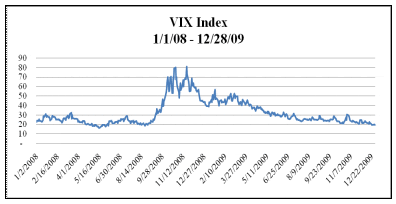
Volatility: Stock market volatility is also being underpriced. The Chicago Board Options Exchange Volatility Index, popularly known as the VIX index, measures the implied volatility of S&P 500 index options and is currently trading at extremely low levels, implying that the market is expecting relatively smooth sailing in the months ahead.
Graph 1 below shows the recovery in the VIX index since the dog days of the 2008 financial crisis:
Graph 1
One of the easier trades that can be made in today’s market is one that bets on volatility rising. Even though HCM expects the stock market to rise for the foreseeable future, this is one relatively inexpensive way of hedging that view.
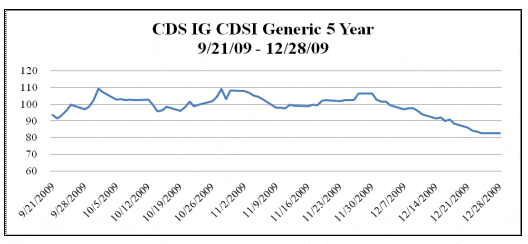
Credit: Another area in which risk is being priced extremely cheaply is corporate bond spreads. Credit default swap spreads on the Markit CDX North America Investment Grade Index, which measures the creditworthiness of 125 investment grade companies in the U.S. and Canada, have tightened inexorably over the course of 2009 and at the end of December stood just above a paltry 80 basis points. This is shown in Graph 2 below.
Graph 2
It is not particularly surprising that these spreads have tightened so dramatically in view of the fact that default risk has receded significantly over the course of the year. The government has made it abundantly clear that it will do everything in its power to reflate the economy, which includes maintaining interest rates at zero and providing liquidity in virtually every form known to man. Moreover, investment grade companies have learned the lessons of the credit crisis and have aggressively moved to extend their debt maturities and improve their balance sheets. Therefore, the default risk on investment grade companies is negligible (barring fraud a la WorldCom or Enron).
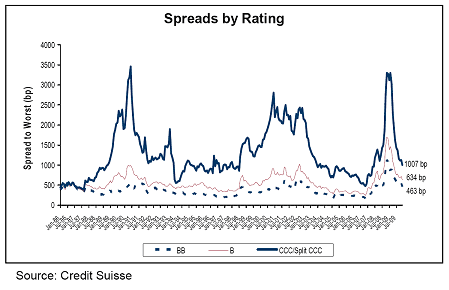
The spread on less-than-investment grade bonds rated B is currently about 650 basis points, which is close to its long-term average. See Graph 3 below. In the current environment, which will be characterized by high levels of new bond issuance and low defaults (under 5 percent), spreads could easily tighten another 100 basis points over the next six months and as much as 150 basis points through the course of 2010.
Graph 3
HCM views this spread tightening as a long-term trap. The pattern in credit markets over the past three decades is for spreads to tighten over a period of years until they snap; when they snap, virtually all of the previous gains earned from spread tightening are lost. Accordingly, it is necessary for investors to be extremely nimble in trading and timing the market; buying and holding has served to be a very poor strategy. This boom and bust pattern has been driven by poor monetary and fiscal policy, which is continuing as we speak. While HCM has every expectation that spreads on investment grade and less-than-investment grade debt will continue to tighten for much if not all of 2010, investors should avoid illiquid names (this is primarily an issue in the junk bond market, not in investment grade bonds). Spread tightening in a zero interest rate environment will lead to a situation, particularly in high yield bonds that are quasi-equity securities, where bonds are severely underpriced for the risks that they pose. This is exactly the situation in which markets found themselves in early 2007 before they collapsed in the credit crisis.
Mexico
Mexican Navy Petty Officer Melquisedet Angulo fought dying for his country. He was killed in a Special Forces operation that killed Arturo Beltran Leyva, a high-profile Mexican drug lord. Mr. Angulo was hailed as a hero and buried with a military honor guard in Mexico City on Monday, December 21. Later that evening, around midnight, a dozen hit men carrying assault rifles burst into the home in eastern Mexico occupied by Mr. Angulo’s family. They murdered his defenseless mother, aunt, sister and brother. Previously, family members were thought to be off limits in the drug wars that are tearing apart America’s southern neighbor. But the public take-down of Leyva was perhaps the most direct challenge to the hegemony of the drug cartels over Mexican society in recent memory, and the public funeral of Mr. Angulo was a further affront to the cartels’ belief that they are beyond the reach of the law. Wiping out Mr. Angulo’s family lent a bloody exclamation mark on their refusal to live under the laws of civilized society.
The drug cartels have deeply corrupted the Mexican government and law enforcement, and it will be very difficult for Mexico to solve this problem alone. While the last thing the U.S. needs is further foreign entanglements, Mexico remains a vital border state whose stability is of vital national importance to this country. Violence has already poured over the border, and the drug trade had caused countless damage to our country.6 The U.S. should treat this issue as a matter of national security and lend its power and military to its neighbor before the Mexican state crumbles into anarchy. Congress is not oblivious to the problem, having agreed to contribute $1.3 billion of aid to Mexico to fight the cartels. The problem will only worsen as the Mexican state suffers further economic weakness with the slow but steady draining of its sole national resource – oil. As noted in last month’s report, Mexico remains a source of economic instability for the U.S., and U.S. investors should pay close attention to what is happening there. The attack on Mr. Angulo’s family is a tragic and historically significant event in Mexico’s decline.
The investment markets are currently undervaluing Mexico risk. As of December 28, 2009, Mexico’s five year benchmark bond, the 5.875s of 2014, were trading at a spread of only 130 basis points over U.S. Treasuries. Mexico’s sovereign credit default swap spreads were trading only slightly wider at 140-145 basis points.7 These spreads are far too tight in view of Mexico’s deteriorating oil industry and the threat posed to civil order by the drug cartels. HCM believes that these spreads are likely to widen significantly in the year ahead and should be shorted.
General Growth Properties, Inc. (GGP)
Hedge fund manager Bill Ackman has been engaged in a public debate about the value of bankrupt mall REIT operator GGP with another money manager, Hovde Capital Advisors LLC. Mr. Ackman, who is a member of GGP’s Board of Directors, believes that GGP’s common stock is undervalued at its current trading price of $11-12 per share, while Hovde argues that the stock is overvalued and could even be worthless. Mr. Ackman’s Pershing Square Capital Management, L.P. has reportedly already earned hundreds of millions of dollars of profits on its positions in GGP’s debt and equity securities, but Mr. Ackman believes there is more to be had from the bankrupt mall operator.
HCM did a little digging into GGP’s numbers and into the analysis on which both Pershing Square and Hovde based their investment recommendations. We came to the conclusion that GGP’s stock is fairly valued at about $12.50 per share. This is based on using a NOI (net operating income) figure for 2010 of $2.29 billion, which is about $200 million lower than the $2.478 billion figure Pershing Square uses in its latest public presentation (dated December 22, 2009, “A Detailed Response to Hovde’s Short Thesis on General Growth Properties,” p. 26) and about $550 million more than the $1.734 billion figure Hovde used in its December 15, 2009 presentation that briefly drove the stock lower. We believe Hovde’s NOI figure is understated because it includes $538 million of non-recurring impairment charges related to GGP’s bankruptcy filing. On the other hand, we believe Pershing Square’s NOI number is too generous because it does not properly reduce recurring cash flow for the costs involved in luring new tenants to the properties. We believe Pershing Square’s analysis of the company’s fundamentals is superior to Hovde’s, but we are more sympathetic to Hovde’s negative long-term view of the retailing and mall businesses and the consumer outlook. We also note that REITs have traded historically at a 7.6 percent capitalization rate, and applying that rate to $2.29 billion of 2010 NOI at GGP gets us to a $12.50 stock price. Pershing Square argues that the cap rate should be below 7 percent (implying a much higher valuation on the company) based on where the market is currently valuing Simon Properties (at a cap rate of about 6.6 percent), which it believes is the most appropriate comparable for GGP. HCM would argue that Simon deserves a lower cap rate (higher valuation) than GGP because its properties are higher in quality by a number of important measures.
We would also concede that a strong stock market, especially one driven by a belief in economic recovery, could lead GGP stock higher over the first half of 2010. One thing is certain – Pershing Square and Hovde will continue to battle it out, and GGP will be a stock to watch in 2010.
Michael E. Lewitt
Disclosure Appendix
This publication does not provide individually tailored investment advice. It has been prepared without regard to the circumstances and objectives of those who receive it. This report contains general information only, does not take account of the specific circumstances of any recipient and should not be relied upon as authoritative or taken in substitution for the exercise of judgment by any recipient. Each recipient should consider the appropriateness of any investment decision having regard to his or her own circumstances, the full range of information available and appropriate professional advice. Harch Capital Management, LLC recommends that recipients independently evaluate particular investments and strategies, and encourage them to seek a financial adviser’s advice. Under no circumstances should this publication be construed as a solicitation to buy or sell any security or to participate in any trading or investment strategy, nor should this publication or any part of it form the basis of, or be relied on in connection with, any contract or commitment whatsoever. The value of and income from investments may vary because of changes in interest rates or foreign exchange rates, securities prices or market indexes, operational or financial conditions of companies, geopolitical or other factors. Past performance is not necessarily a guide to future performance. Estimates of future performance are based on assumptions that may not be realized. The information and opinions in this report constitute judgment as of the date of this report, have been compiled and arrived at from sources believed to be reliable and in good faith (but no representation or warranty, express or implied, is made as to their accuracy, completeness or correctness) and are subject to change without notice. Harch Capital Management, LLC and/or its employees, including the author, may have an interest in the companies or securities mentioned herein. Neither Harch Capital Management, LLC nor its employees, including the author, accepts any liability whatsoever for any loss or damage arising from any use of this report or its contents. All data and information and opinions expressed herein are subject to change without notice.
The HCM Market Letter
Michael E. Lewitt, Editor
The HCM Market Letter is published on a monthly basis by The HCM Market Letter, LLC. Offices at One Park Place, 621 NW 53rd Street, Suite 400, Boca Raton, FL, 33487. Telephone (561) 226-6199; Fax (561) 995-4946. Delivery is by electronic mail. Annual subscription rate is $395 for individuals and $995 for institutions. Visit our web site at www.hcmmarketletter.com. Copyright warning and notice: It is a violation of federal copyright law to reproduce or distribute all or part of this publication to anyone (with the exception of individuals within the same institution pursuant to the subscription agreement) by any means, including but not limited to photocopying, printing, faxing, scanning, e-mailing, and Web site posting without first seeking the permission of the publisher. The Copyright Act imposes liability of up to $150,000 per issue for infringement. Information concerning possible copyright infringement will be gratefully received.
6After this was initially written, an American citizen (an El Monte, California school board member, Bobby Salcedo), was abducted and murdered along with five other men in the state of Durango, Mexico on December 31. It is unknown whether the murder was drug or cartel related.
7Price source: Goldman Sachs Group, Inc.
Read more articles by Michael Lewitt