It ain't what you don't know that gets you into trouble. It's what you know for sure that just ain't so.
Mark Twain
Our beliefs about risk and return determine how we construct portfolios and manage risk. Research over the last decade suggests that a number of the ideas on which many investors and advisors rely lead to portfolios that are too highly exposed to market risk. Recent years have vividly demonstrated the perils of such portfolios.
In this article, I will review a number of ideas that determine how we select assets and how we determine what to expect from those assets. I start with the ubiquitous CAPM model and work forward through more recent work. I will then demonstrate how flawed assumptions about available opportunities can handicap portfolio performance, and I will show that rejecting the assumption that investors are not compensated for idiosyncratic risk can be an important way to enhance returns.
As the quote at the introduction of this article suggests, the biggest threat to effective asset allocation is not that we have an incomplete model for understanding risk and return (though we do), but rather that the assumptions we have made about risk and return may be leading us to sub-optimal choices.
Concept 1: The capital asset pricing model (CAPM)
Investors willing to take on more market (systematic) risk will ultimately be rewarded with higher returns, but the (unsystematic) risks specific to individual companies provide no value and thus should be diversified away. That, in a nutshell, is the core foundation of CAPM, the paradigm for portfolio construction that won Bill Sharpe the Nobel Prize in Economics in 1990. Using those two core ideas as a roadmap, we end up with a world view in which the only way to increase portfolio return is to add more market risk. The key idea here is that a single factor determines the risk and return of a portfolio: beta, a measure of market risk.
If CAPM is correct, the only type of risk that investors will be rewarded for taking is market risk. Rational investors will diversify away as much non-market risk as possible (i.e. by holding large numbers of stocks weighted on the basis of market capitalization). The CAPM construct leads directly to the idea that investors are well-served by diversified mutual funds rather than holding a smaller number of individual stocks. Furthermore, the only way to achieve higher returns is to create a portfolio with higher beta than the market.
CAPM also leads to the idea that
commodities and gold have very low expected return because the betas of their indexes relative to the S&P 500 are low. CAPM must be
substantially modified to rationalize any exposure to commodities.
Concept 2: Factor models
The CAPM is a ‘single factor’ model; the more general approach in factor modeling is the three-factor model created by Fama and French. Fama and French famously identified that the size of a company (its market capitalization) and whether the company was a value stock or a growth stock (as measured by its price-to-book ratio) were important in determining expected return. Later work by added a fourth factor: momentum. In an important 2003 research paper, The Capital Asset Pricing Model: Theory and Evidence, Fama and French provide a comprehensive summary of research around factor models and CAPM. They conclude the following:
Because of the empirical failings of the CAPM, even passively managed stock portfolios produce abnormal returns if their investment strategies involve tilts toward CAPM problems. … For example, funds that concentrate on low beta stocks, small stocks, or value stocks will tend to produce positive abnormal returns relative to the predictions of the Sharpe–Lintner CAPM, even when the fund managers have no special talent for picking winners.
The research of Fama and French suggests that we can create portfolios that emphasize certain factors that will add return that is not captured by beta. In particular, they find that small-cap stocks, value stocks, and low-beta stocks all lead to outperformance. Their value and size factors have influenced portfolio construction throughout the industry, but the low beta effect is not as well understood.
The three- and four- factor models are currently a dominant paradigm. Advisors develop portfolios with factor tilts to enhance the returns of the portfolio. The factor models still assume (a) that the performance of the portfolio is determined only by beta and a few specific factors; and (b) that company-specific risk is uncompensated. According to these multi-factor models, investors should still diversify away as much company-specific risk as possible, and this source of risk is simply pure noise.
Concept 3: Idiosyncratic risk adds to return
Under the CAPM and the three- and four-factor models, there is a central assumption that any volatility (risk) that is not attributable to one of the ‘factors’ (beta, size, value, and momentum) will not be rewarded with higher expected returns. Research over the last decade suggests that this argument is not well-supported. A 2004 study co-authored by Burton Malkiel, a professor of economics at Princeton and author of the investing classic A Random Walk Down Wall St., argued that idiosyncratic risk in a portfolio did, in fact, add to expected return. This analysis uses data from the CRSP dataset from 1975-2000. Its two main conclusions are:
(1) Idiosyncratic volatility by itself is important in explaining cross-sectional expected return differences
(2) The explanatory power [of idiosyncratic risk] does not seem to be taken away [diminished] by other variables, such as size, book-to-market, and liquidity
Cross-sectional returns refer to returns in groupings of stocks with different levels of idiosyncratic risk. Portfolios with higher levels of idiosyncratic volatility tend to outperform portfolios with lower levels of idiosyncratic volatility, after accounting for differences from the three-factor model.
A 2005 study at Yale also examined these effects and came to very similar conclusions. Portfolios of stocks with higher levels of idiosyncratic risk have higher expected returns. The Yale study used the standard CRSP dataset with monthly data from 1962-2003.
Perhaps the biggest problem for investors who want to create portfolios from funds with higher levels of idiosyncratic risk is that this type of risk is, by definition, not attributable to specific factors. As such, it will be very hard to determine whether performance is due to manager skill or simply to noise. Random trading activity in a fund can lead to higher levels of idiosyncratic risk, with no increase in expected performance.
How models motivate investing style
Our investing behavior is determined by the hierarchy of these risk-return concepts and where we place ourselves within it. If we believe in CAPM, we can conclude that we need only three asset classes: bonds, cash, and a market-cap weighted equity index. The only risk that is rewarded is beta risk, captured by a market-cap weighted index. If you want higher returns, you must take on more beta. Higher-return portfolios are increasingly leveraged against the market – higher beta means that you are amplifying your exposure to the market-cap weighted index.
Following the paradigm established by Fama and French and later work on factor models leads to tilting a portfolio toward small-cap and value stocks.
Oddly enough, the research into the role of idiosyncratic risk brings us back to the pre-CAPM idea that expected return scales with total risk, which is the risk that we can estimate by looking at historical volatility. In this view, however, it is not optimal to diversify away as much stock-specific risk as possible to create the portfolio with the highest expected return for a given level of risk. Furthermore, once we move to a model in which total risk determines expected return, commodities and gold become attractive asset classes, depending on the target risk level of a portfolio.
The research that suggests that idiosyncratic risk is not something to be minimized has important implications for mutual funds and ETFs. One of the standard arguments in favor of funds is that they diversify away idiosyncratic risk. This is an attractive feature of funds only if we have already assumed that idiosyncratic risk adds no value. If both idiosyncratic risk and market risk add to expected return, and total return is what matters, then portfolios that hold smaller numbers of individual stocks can have higher expected returns relative to risk than those that buy the entire market.
In particular, a portfolio of individual stocks with low beta is very attractive. Lower-beta stocks tend to have lower correlation to one another, so the aggregate portfolio can have higher expected return for a given level of risk.
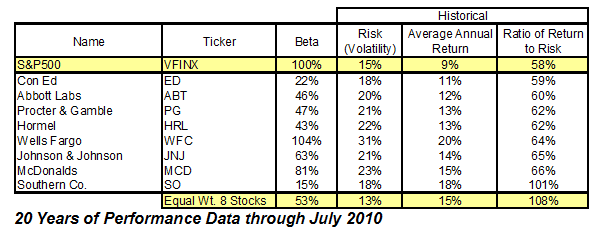
Why should it be inconceivable that holding a fairly small number of stocks in companies with stable earnings histories would be superior to simply buying all 500 stocks in the S&P 500? A range of companies have generated long-term returns that are superior to that of the S&P500 on a risk-adjusted and absolute basis. Eight of these stocks are listed below, along with their risk and return over the past 20 years:

Over this 20-year period, every one of these stocks outperformed the S&P 500 on a risk-adjusted basis (the ratio of average annual return to annualized volatility, above). When we combine these eight stocks at equal weights in a portfolio, it has a much higher risk-adjusted return, thanks to diversification among the individual stocks. The diversification benefit of combining assets depends on the correlations between them. While correlations among broad asset classes have been increasing in recent years, there is evidence of a gradual reduction in correlations among individual stocks. The increased diversification potential provided by low correlations allows us to create portfolios with higher expected return for a given level of risk.
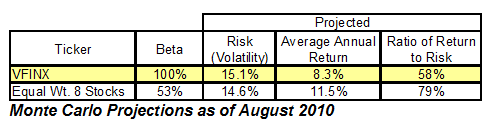
The much higher returns generated by the eight-stock portfolio over the past 20 years are not something that we can count on persisting. Historical performance of portfolios is a notoriously poor predictor of future performance. I have run a forward-looking Monte Carlo model to provide for a more realistic assessment of reasonable expected returns.
The Monte Carlo model that I developed, QPP, is consistent with the idea that expected return scales with total risk, not just beta risk. The Monte Carlo projections are shown below:
These projections still suggest a substantial benefit to the equal-weighted eight-stock portfolio over the S&P 500, but the expected future benefit is much lower than the differential was over the last 20 years.
When I run the Monte Carlo using data through July 2007, before the crash, those projections also expected notable outperformance from the equally weighted eight-stock portfolio. Over the three years from August 2007 through July 2010, that portfolio provided an average return of about 8.5% per year, as compared to about -5.0% per year for the S&P 500.
These results do not imply that a portfolio with this small a number of stocks is optimal or even a good idea. All models are imperfect. Limitations in models (in general) can partly be accounted for by taking a larger number of positions. The point of showing these calculations is to demonstrate how a world view in which total risk (market risk plus idiosyncratic risk) determines expected returns will clearly lead to different portfolio strategies than a world view based on CAPM or factor models.
Implications
While CAPM and its successors created a powerful reason to use market-capitalization-weighted mutual funds, the newer research makes a case for portfolios that hold significant idiosyncratic risk. These portfolios will tend to be lower-beta (because we no longer believe that beta is necessary for higher return), and there is no reason for them to hold hundreds of stocks.
Portfolios with smaller numbers of stocks are naturally exposed to higher default risk. Investors can reduce default risk by carefully screening stocks on the basis of their volatility. By setting a reasonable upper-bound on the volatility of individual stocks, the probability of selecting the stock of a company that will go bankrupt declines markedly.
There is a tradeoff between market risk and company-specific risk in portfolios with smaller numbers of stocks. A portfolio with a large number of holdings is more exposed to default risk, but the benefit of holding individual stocks is that we can exploit the relatively lower correlations among them to create a low-beta portfolio with attractive expected return.
Based upon the research into idiosyncratic risk and return, it is not possible to argue that a carefully selected portfolio of 20 individual stocks is inherently inferior to an index fund. While index funds remain the best solution for many investors, we will see increased focus on portfolios that hold far smaller numbers of stocks than the total market, but which can outperform an index fund on an absolute and risk-adjusted basis. A portfolio holding a good selection of Dividend Aristocrats, typically high-quality stocks with low-to-moderate betas and volatility, can be expected to continue to outperform. That said, individual investors should not simply rush out and buy a handful of individual stocks as soon as they finish reading this article – intelligent selection is required.
While many advisors and investors remain stuck in the old paradigm that idiosyncratic risk has no value and should be minimized, research over the last decade has discredited that dogma. Investors and advisors who believed that they need to add market risk (via higher beta) in order to achieve higher returns have ended up amplifying their exposure to systemic risk, with costly consequences. There has never been a more opportune time to stop and reconsider the conceptual models that motivate our investing decisions.
Geoff Considine is the author of a new book, Survival Guide for a Post-Pension World, as well as a book on the use of options strategies in wealth management. More information is available at www.quantext.com.
Geoff’s firm, Quantext is a strategic adviser to FOLIOfn,Inc. (www.foliofn.com), an innovative brokerage firm specializing in offering and trading portfolios for advisors and individual investors.
Read more articles by Geoff Considine, Ph.D.