As they approach retirement, baby boomers are increasingly concerned about how best to manage their portfolios during the decumulation phase of their lives. One of the challenges for advisors and investors is understanding what role annuities should play, if any.
Advisors have stridently criticized many annuities for their high fees and complex, hard-to-understand structures. I will not focus on the merits of those criticisms. Instead, I will show why one type of annuity – the immediate annuity – can play a valuable role in a decumulation strategy.
Among the many types of annuity contracts, I will analyze single-premium immediate annuities (SPIA’s) in which an investor pays a lump sum to an insurer, in return for a guarantee of a specific annual income for the balance of an investor’s life.
One basis for comparison is to compare the income streams from alternative strategies to annuities. In a recent article, for example, Investment News compared corporate bond yields and annuity payouts. In the current environment, corporate bonds appear to be a far more attractive bet on the basis of yield alone. We cannot, however, legitimately compare the higher yield on long-maturity corporate bonds to the payouts from annuities without also accounting for the risks associated with corporate bonds.
Advantages and disadvantages of annuities
The advantage of an annuity contract is straightforward. The annuity mitigates longevity risk — the risk that an investor will live sufficiently long in retirement to entirely deplete their assets. This risk is not trivial. A recent Wharton study found that a healthy 65-year-old man has a 50% chance of living beyond age 85 and a 25% chance of living beyond age 92. A healthy 65-year-old female has a 50% chance of living beyond age 88 and a 25% chance of living beyond age 94.
The seller of the annuity pools contracts sold to a large number of investors. An annuity holder who dies early provides the additional assets to offset the burden of providing income to an annuity holder who lives longer than expected. The diversification of individuals’ longevity risk in annuities provides a unique hedge against longevity risk that cannot be directly achieved through any other asset class. This is the unique value proposition that annuity sellers provide: They can diversify away longevity risk, while individual investors cannot.
The potential downsides to purchasing an immediate annuity are that (1) the decision is irreversible; (2) it offers no wealth transfer to heirs; (3) the seller of the annuity may default; and, (4) standard annuity contracts provide no protection against inflation. These are all real risks.
On the other hand, longevity risk is also a very real risk. The default risk for an annuity contract is small and hard to quantify, but potentially catastrophic. The Wharton study cited above suggests that the rational allocation to annuities drops substantially as credit risk is considered. This makes sense, but there is enormous uncertainty in trying to estimate default risks of firms.
Annuities vs. alternatives
There are three standard approaches to providing income in retirement for those who do not have traditional, defined-benefit plans:
- Use portfolio yield as income
- Systematically withdraw of assets
- Annuitize
I explored income investing in a recent article. The goal of the income investor is to draw only the income generated by the portfolio and leave the principle intact. The income generated by a portfolio and its market value will vary over time, however, even if the income portfolio is invested in a risk-free asset. In the second approach, the so-called Systematic Withdrawal Plan (SWP), the investor draws a specific amount from the portfolio that may include various forms of income generated by the portfolio and/or proceeds from selling assets.
Income investing is a variant of the SWP, of course. In both cases, the investor creates a portfolio intending for it to provide a stream of future income. The traditional income investor, however, tries to generate this income without selling assets and has no longevity risk – he will never totally draw down his portfolio because he never sells assets.
Traditional income portfolios are not without risk,of course In the Investment News article cited above, the author suggests that an income investor can generate an effective 5.7% to 5.8% safe withdrawal rate with a portfolio of corporate bonds. My recent article on income investing discussed the investment-grade bond ETF (LQD), which has expected annualized volatility of 15% and yield of 5.3%. Higher yields naturally come with higher risks. I discussed the relationships between bond yield and risk in detail. The yield from risky corporate bonds cannot be substituted for a safe withdrawal rate, as discussed later in this article. In the recent Investment News article, the author was assuming that the yield on corporate bonds could be treated as essentially risk-free.
Comparing alternatives
To compare annuities to SWPs and income-investing strategies, one must account for the risk and return of each strategy. To do this, I use a Monte Carlo simulation of strategies that provide constant income streams. I look at three cases:
• Purchasing annuities at age 65 with 100% of one’s assets
• SWP starting at age 65
• 50% of portfolio in annuity and 50% of portfolio in SWP
In this process, I am relying on the ability of Quantext Portfolio Planner (QPP) to capture the risks associated with various investment alternatives. QPP makes projections for the risks associated with various bond alternatives, including the risk of default, and we have demonstrated in the past that these projections are consistent with the implied volatility in options on both investment-grade corporate bonds and high-yield bonds.
One challenge is capturing the default risk of the seller of the annuity. If annuity purchases are spread between multiple firms, the default risk is lower. To account for annuity default risk, I have added a model factor for the failure probability of the annuity seller as a user input. Even a very small probability of default in any single year can add up to a significant probability of failure over a 30-year retirement, which in turn reduces the attractiveness of annuities.
Not surprisingly, the relative attractiveness of our three alternative scenarios depends very much on the expected risk and return for the portfolio used for the SWP. We will start by assuming that the SWP portfolio is invested entirely in corporate bonds. For investment-grade corporate bonds, I will use LQD as the proxy. As I showed in a recent article, the yield for LQD is 5.3% with long-term annualized volatility of 15%. The three-year trailing annualized volatility for LQD is 13.77% and the two-year trailing annualized volatility for LQD is 15.95%, so our projected volatility is consistent with recent years. The volatility on a bond index fund like LQD reflects uncertainty in the market price of the bonds that the fund holds, the probability of default, and the probability that bonds in the fund will be called.
Our model investor retires at age 65. The web site ImmediateAnnuities.com estimates that a 65-year old male can purchase an SPIA that provides $74,000 per year for $1,000,000. This is for an annuity with no payouts to beneficiaries. (If you want a guaranteed benefit for a minimum of 20 years, the annual income from the annuity is $65,500. If you die before twenty years have passed, your heirs will continue to receive payments until year 20.)
For the annuity, I have assumed a 0.5% failure probability in any 12-month period. This figure is highly approximate. A recent study of 150 years of data on corporate defaults estimated that the average annual default rate on corporate bonds is 1.5% per year, although the default rate varies enormously among bonds and through time. I assumed that the sellers of annuities would have a default rate that is 1/3 of the long-term average for all corporate bonds.
Put another way, I assumed that there is a 1-in-200 probability of failure in any year for a company selling annuities. This is a very small, but non-negligible, risk. We will explore variations around this value for default. While I have been unable to find comprehensive data on default rates for annuity issuers, the National Organization of Life and Health Insurance Guarantee Association (NOLGHA) lists 68 major insurer insolvencies since 1991 (their definition of major being that policyholders in more than three states were affected).
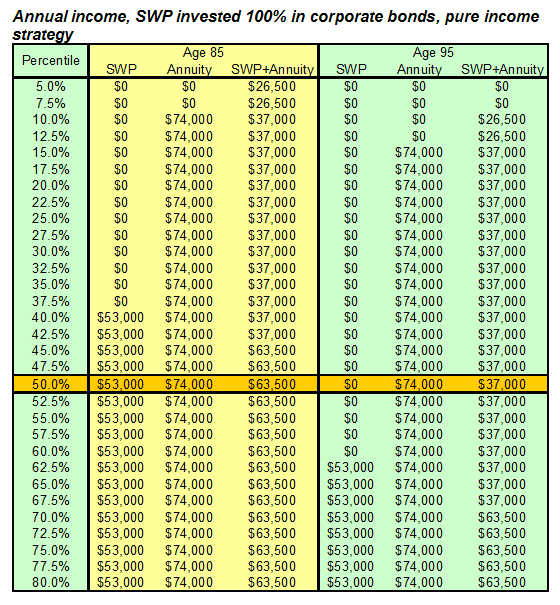
Let’s start with a sample case, in which we’ll assume that our model investor can survive on the coupon income from a portfolio of investment-grade corporate bonds (via LQD), so he plans to be the classic income investor. He plans to draw $53,000 per year on his bond portfolio. If he buys the SPIA, he can draw $74,000 per year. If he splits his portfolio equally between the SPIA and the bonds, he will plan to draw $63,500 per year.
The results in the table below show the probability that a strategy will provide a specific amount of income at two points in our investor’s future: age 85 and age 95.
Our model investor has a 37.5% chance of having zero income by age 85 when he invests only in the corporate bonds (see table below) and uses a SWP with a fixed annual draw of $53,000. The probability that his money will run out by age 85 owes primarily to investment risk – the variability in the returns the portfolio may provide from year to year. Some fraction of the bonds in the portfolio will default, some may be called, and our model investor may need to sell some fraction of the portfolio to maintain the $53,000 in income per year. There is no guarantee that we might not draw down a portfolio of corporate bonds, even if we plan to draw an amount provided by the yield at the time of retirement. This example highlights why it is so important to include risk in any discussion of safe withdrawal rates. To ignore risk — and simply assume that you can draw 5.3% from a corporate bond portfolio because that is the current yield — is dangerously simplistic and implies that corporate bonds are risk-free.
Over the 20-year period between age 65 and age 85, the pure annuity investment has better than a 90% chance of providing $74,000 per year.
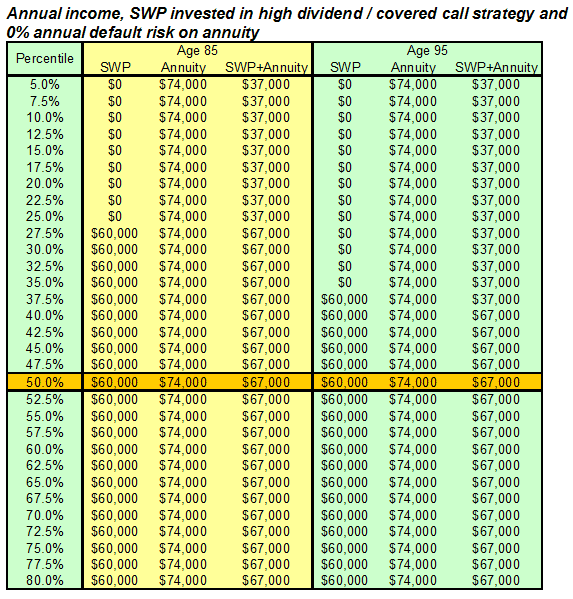
The combination of SWP plus annuity has the highest probability of providing income through age 95, although the annuity is expected to provide considerably higher income through age 95. If there is no default risk for the annuity, the annuity will provide $74,000 at every percentile and the combined strategy will provide a minimum of $37,000 in the worst case.

These results suggest that simply buying corporate bonds as an alternative to an annuity is not a great solution. One of the reasons that the corporate bond portfolio does not look attractive is that we have adjusted QPP so that the expected volatility of the model is consistent with long-dated options on the S&P500. This higher-than-average volatility means the expected volatility of corporate bonds is higher than its long-term historical average. Our model is suggesting that the risk in corporate bonds gets higher when market volatility is higher – a conclusion research backs up. Our outlook is partly driven by projections for market risk that are higher than the average over the last 50 years.
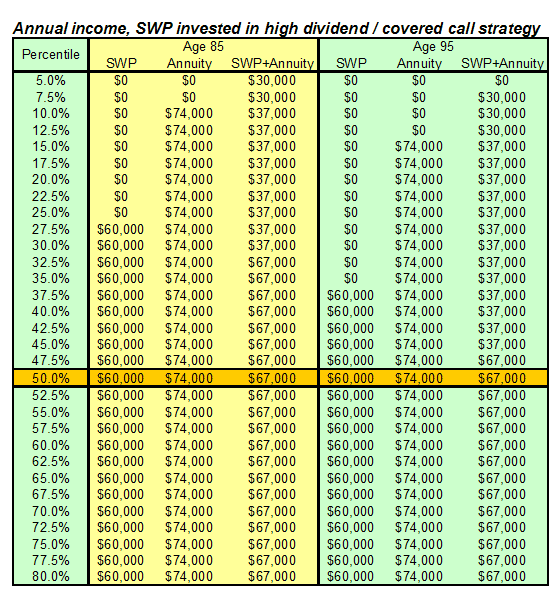
In a recent article, I examined alternative income-oriented portfolios. The most attractive of the strategies was a portfolio of corporate bonds and high-yield stocks against which we sell call options. This portfolio had a current yield of 9.7% (dividends plus premiums from selling covered calls), but it also has an expected annualized volatility of 21%. Because of this high volatility, we must plan on drawing substantially less than the current yield. If we assume a 6% draw rate ($60,000 per year on $1,000,000 invested), how do things look?
The outcomes suggest that the high-dividend/covered-call strategy will provide considerably more income more reliably than the SWP invested purely in corporate bonds. Nonetheless, when our model investor splits his portfolio equally between the annuity and the SWP, his odds of being able to provide long-term income improve considerably. Furthermore, the SWP-plus-annuity portfolio has a median value of $1,000,000 when the model investor reaches age 95. The pure SWP has a median value of $1.3M at age 95, but the 100% SWP strategy also leaves our investor with a much higher probability of having no income at all by age 95.
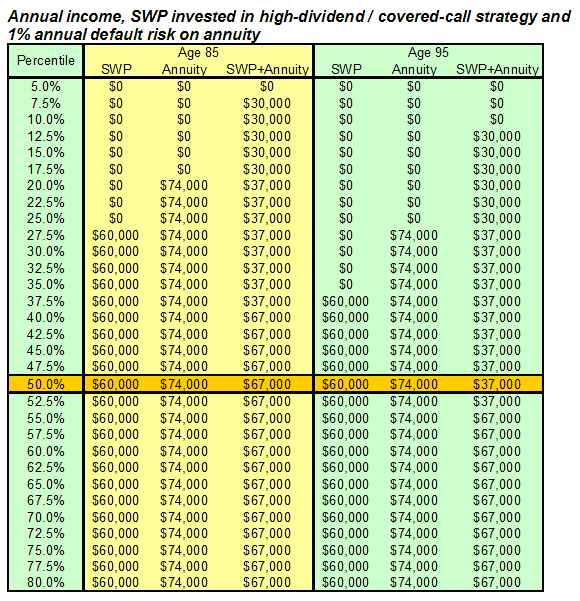
Next, let’s compare the high-yield/covered-call strategy to the annuity when the annual probability of default for the annuity is 1% rather than the 0.5% we have used in previous examples (see table below). We can consider this a stress test of the pure annuity portfolio.
As we might expect, the annuity looks less attractive relative to the SWP when the risk of default in the annuity increases. Other work has demonstrated this result with more depth.
Conversely, the annuity looks more attractive if the default risk is zero:
Overall, these results suggest that even with considerable uncertainty in the risk of default by the seller of the annuity, annuities still make a great deal of sense as one component of the portfolio.
As I noted earlier, however, the size of the annuity investment will depend on the specifics of an investor’s risk tolerance, wealth level, and goals.
Discussion
Planning for the decumulation phase of life will receive increasing emphasis as the first wave of self-directed, defined-contribution plan investors enters retirement. Annuities provide important benefits as one component of the long-term portfolio. The fraction of wealth that an investor may consider for an annuity purchase depends on a range of factors. Wealthier individuals may be able to afford to self-insure by drawing small fractions of their portfolios as income or by living on the portfolio yield alone. Investors who are at risk of not having sufficient sustainable income in retirement should consider a higher level of annuitization. Investors who are more risk-averse are likely to annuitize a larger fraction of their portfolios, and those who have a strong desire to leave an estate to their heirs or charity should annuitize a smaller fraction of their portfolios.
Partial or total annuitization is a cheaper way to protect against longevity risk than an SWP alone. This finding is consistent over a substantial range of assumptions about default risk in the annuity. My results are consistent with other research demonstrating that annuities can be an effective tool to manage longevity risk.
Moshe Milevsky, a pensions expert, has coined the term ‘product allocation’ (as opposed to asset allocation) for the process of choosing how much of a portfolio will be in a SWP and how much will be in annuities and other financial products, in order to help investors more directly manage longevity risk. In coming years, we will see considerable attention given to product allocation decisions.
Geoff Considine is the author of a new book, Survival Guide for a Post-Pension World, as well as a book on the use of options strategies in wealth management. More information is available at www.quantext.com.
Geoff’s firm, Quantext is a strategic adviser to FOLIOfn,Inc. (www.foliofn.com), an innovative brokerage firm specializing in offering and trading portfolios for advisors and individual investors.
Read more articles by Geoff Considine, Ph.D.