Income investors seek a substantial, long-term income stream from their portfolios, and they don’t want to rely on capital appreciation or to deplete principal. Also seeking income may be investors who do not want to rely on economic growth to fuel returns on their investments.
Conventional approaches to constructing income-oriented portfolios use either bonds or high-yield stocks. In this article, we will explore a compelling alternative to that approach: a carefully selected model high-yield portfolio consisting primarily of low-beta, high-dividend stocks, against which the investor sells call options.
Such a portfolio has many advantages over conventional approaches. It produces more income, has less risk, and has lower correlation to interest rates. Income-oriented portfolios made up of long-term government bonds and high-yield corporate bonds will look attractive in some market conditions, but the high-yield / covered call strategy looks more attractive in others, including the current conditions.
Choosing the desired exposure of a portfolio to interest rates is an important tactical consideration, as is recent performance relative to expectations. In the last three years, long-term and intermediate-term government bonds have generated high total returns, and yields on these asset classes are now very low. A major question from a tactical standpoint is whether government bonds are poised to under-perform. In addition to having under-performed in recent years when it comes to total return (and thereby having attractive valuations), many high-yield stocks are currently providing very high dividends.
The model high-yield portfolio
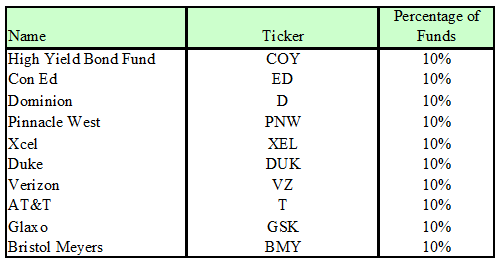
Consider the following portfolio, which I constructed by choosing a number of high-yield, low-beta, moderate volatility stocks.

The total yield on this portfolio is 6.1%, more than 50% greater than the 3.90% that long-term government bonds offer. This portfolio has also been slightly less risky (measured by annualized volatility) than long-term bond ETF TLT in the last three years. Although my Monte Carlo simulations suggest that this portfolio is slightly more risky than TLT on a forward-going basis, its risk level and that of TLT are comparable in the long term.
As noted previously, one of the most crucial issues for income-oriented investors is the exposure of the portfolio to changes in interest rates. Long-term government bonds naturally correlate highly with shifts in interest rates. Increases in interest rates tend to correspond to increases in inflation, so an investor who relies on long-term bonds may see his real purchasing power decline.
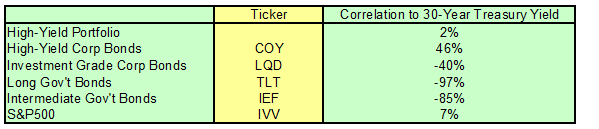
A simple way to illustrate the exposure of various asset classes to interest rates is to calculate the correlation of their total returns to the yield on 30-year Treasury bonds. Those correlations are shown below, using ETFs as a proxy for different asset classes.
Three-Year Correlations
A zero correlation means that the total returns are completely independent of interest rates. A 100% correlation would mean that the total returns move in lockstep with interest rates, and a -100% correlation would mean that an increase in rates perfectly predicts a decrease in total returns, and vice versa. Our model high-yield portfolio is essentially neutral with respect to interest rates – there is a small positive correlation of 2%.
As the prices of long-term bonds rise, their yields decrease. This effect is easily observed in the -97% correlation between the total returns on TLT and Treasury yields. This effect becomes less pronounced for shorter-term bonds, as the table above shows. Investment-grade corporate bonds exhibit a clear negative correlation to interest rates, but not to the same extent as government bonds. High-yield corporate bonds exhibit a fairly strong positive correlation to interest rates, albeit one that varies with the specific construction of a fund or index. The Vanguard high-yield corporate fund, VWEHX, has a correlation of 24% with the 30-year Treasury yield.
Taking risk into account
So far, we have not explicitly considered risk. High-yield bonds, after all, are far more risky than investment-grade corporate bonds. Any comparison of income-oriented strategies must take these risk differences into consideration. The table below shows expected yield (from Morningstar) vs. expected volatility (risk) and expected return for our model high-yield portfolio, along with a series of reference asset classes.
Total Return, Yield, and Risk
The expected risk and return levels are generated using my Quantext Portfolio Planner, with the forward volatility of the S&P500 adjusted to be consistent with the implied volatility on long-dated options on the S&P500. Using that information, the model then projects volatility for the components of the portfolio and for the other asset classes.
The expected volatility of long-term government bonds is 20%, which is unusually high historically. The longest dated options on TLT (expiring in January 2012) have implied volatility of 20.4% as of this writing. For reference, the long-term historical average volatility for the S&P500 is around 15%. For the level of income, long-term government bonds are not attractive.
When both income and risk are considered, investment-grade corporate bonds (LQD) emerge as fairly attractive. High-yield bonds have higher yields but higher risk. There can be considerable variability among high-yield bond indexes in terms of yield and risk. Vanguard’s high-yield fund, VWEHX, has a yield of 7.8% and a projected volatility (from QPP) of 18%, but QPP projected a total return of 6.2%. The yield/risk relationship for VWEHX is very different than we saw for COY (see table previous page).
Once we look at yield and risk together, long-term and intermediate-term government bonds are not very attractive. A high-yield fund like VWEHX looks quite attractive in the current environment, hence our allocation to high-yield bonds (using COY) in the model portfolio. In addition, the model high-yield portfolio has higher potential for capital appreciation. My simulations suggest that VWEHX has an expected long-term return of 6.2% vs. 8.4% for the model high-yield portfolio. The model high-yield portfolio has an additional source of income because of this potential for capital appreciation, as I discuss in the next section.
I have focused on securities with qualified dividends. Depending upon your tax situation, it may also make sense to add allocations to REITs and MLPs to the mix. Currently, REITs look fairly unattractive from the perspective of yield vs. risk. The REIT index ETF RWR has a yield of 3.4% vs. expected volatility of 41.6%. Kinder Morgan, a large energy MLP, has a current yield of 6.7% vs. expected volatility of 22.6%. This is pretty good, but the earnings per share are far below what it needs to sustain such a high dividend.
Selling covered calls to increase income
An additional strategy for increasing income from a portfolio is to sell call options against the portfolio holdings.
We selected stocks for our model high-yield portfolio that have fairly low betas (an average of 57%) with respect to the S&P500. This criterion for choosing stocks is especially attractive for covered call strategies. In a 2008 paper titled Implied and Realized Volatility in the Cross-Section of Equity Options, Manuel Amman of the Swiss Institute of Banking and Finance and his co-authors found that the implied volatility of low-beta stocks tends to be consistently too high. I have also documented this effect in my own research. This means that investors will tend to be paid more than fair value for selling covered calls against low-beta stocks.
By way of example, here are the prices of the out-of-the-money call options on each of the nine stocks in the model-high yield portfolio (as of 6/30/2010). I have used the longest-dated options available.
The annualized returns from selling covered calls are substantial. The longer-dated options are preferable, of course, but the longest date for an option varies between stocks.
With 10% of the portfolio in each of these nine stocks, we can add an annualized 3.6% to the income from the high-yield portfolio by selling call options against its holdings. Added to the dividend yield of 6.1%, this brings the total annual income from the portfolio to 9.7% per year.
Selling the covered calls raises the income from the portfolio, and while it does not affect its downside volatility, it does limit upside potential. By selling covered calls, we have a total yield of 9.7% with expected volatility of 21%. To put this in context, selling covered calls gives a yield that is more than 2.5 times what long-term government bonds can offer, but with almost identical risk.
Another way to look at these results is that the covered-call high-yield strategy provides 0.8% less in yield than the high-yield corporate bond ETF COY, but with much lower volatility (21% annualized volatility vs. 36%). One might argue that the strategy of selling covered calls is unlike a long position in either COY or TLT because we have sold off most of the potential for price appreciation. The yields on both TLT and COY are so high relative to their expected returns, however, that there is not much upside potential left in these ETFs.
One of the very useful features of ETFs for income investors is that many have options on them. In a recent article, I discussed buying puts on a long-term bond ETF, TLT. Investors who want to compare income strategies like those outlined here, but with ETFs instead of individual stocks, might consider buying a dividend-oriented ETF, such as the iShares Select Dividend Index (DVY), and selling call options against it. As of this writing, the longest-dated options on DVY expire rather soon, in December 2010, meaning that the investor would have to sell additional options in six months. DVY has a yield of 3.9% with implied volatility of about 23%. Selling a covered call with a December 2010 expiration can add another 3.1% in income between now and the end of the year. On an annualized basis, selling the covered call brings the total yield up to a bit more than 10%. The Utilities Select SPDR, XLU, has options with expiration dates out to January 2012 with implied volatility of about 23%. Selling slightly out-of-the-money January 2012 call options against XLU brings the combined yield of the ETF plus option premium up to 7.1%.
Conclusions
We have explored income investing by analyzing yield vs. risk, along with the sensitivity of each investment alternative to changes in interest rates. In the current environment, long-term government bonds are unattractive because of their high sensitivity to interest rates, their low yields, and their high risk. Investment-grade corporate bonds are more attractive, with lower risk, higher yield, and lower sensitivity to interest rates. High-yield corporate bonds have very high yields and positive correlation to interest rates, but they are risky (depending, of course, on the credit characteristics of the bonds).
A portfolio made up mainly of high-yield stocks is quite attractive. My example here has a 6.1% yield with 21% volatility and a near-zero correlation to long-term rates. This portfolio is comparable on a risk-adjusted basis to one that is 40% COY and 60% TLT, which also has a yield of 6.1% but with expected volatility of 13.4%. This portfolio also has a modest positive correlation to long-term rates.
In the current environment, the best solution is to sell covered calls against the stocks in the model high-yield portfolio. This portfolio provides 9.7% in income with 21% in expected volatility. No combination of bond ETFs can provide this level of income with comparable risk, meaning that income investors who aren’t looking to go for broke will be hard-pressed to find a more optimal portfolio.
Comparing yield to expected volatility as a way to analyze income portfolios makes a great deal of sense. Further, to the extent that we only want to compare individual stocks or ETFs, all we have to know is the implied volatility from options and the current yield. To analyze portfolios and mutual funds, we need to take the next step by using Monte Carlo simulations to account for the correlations between holdings in a portfolio, and thereby come up with a consistent estimate of total expected volatility.
The ultimate income portfolio will be quite attractive if the “New Normal” worldview espoused by PIMCO, with its forecast of higher interest rates and stunted economic growth, should come to pass. In such an environment, dividends will likely make up a larger fraction of total returns from equities, and selling off the potential for capital appreciation via call options is likely to be a smart choice.
Geoff Considine is the author of a new book, Survival Guide for a Post-Pension World, as well as a book on the use of options strategies in wealth management. More information is available at www.quantext.com.
Geoff’s firm, Quantext is a strategic adviser to FOLIOfn,Inc. (www.foliofn.com), an innovative brokerage firm specializing in offering and trading portfolios for advisors and individual investors.
Read more articles by Geoff Considine, Ph.D.