The devastation caused by the crash of 2008 was not limited to individual retirement portfolios. The endowments of most prominent universities suffered terribly, causing many of these institutions to drastically slash budgets and cut back planned capital spending.
Yale may have the most respected investment acumen, thanks to its manager, David Swensen, who is credited with developing the “endowment model,” a paradigm he has refined over his quarter-century tenure at the university. Yale’s performance during the 2008 crash was far from stellar, however, leading many to question the validity of the assumptions that underlie the endowment model.
By constructing a portfolio that serves as a proxy for Yale’s and simulating it using Monte Carlo analysis, I show that Yale’s performance was worse than what would be mathematically expected, but not significantly enough to question the endowment model’s tenets.
Moreover, Yale’s performance and philosophy suggest two very important lessons for advisors and investors – to diversify beyond equities and fixed income, and that some illiquid asset classes can be an important source of alpha.
Swensen’s endowment model posits that portfolios must be diversified far beyond public equities and bonds in order to generate the most attractive risk-adjusted returns. The alternative asset classes it advocates include commodities, real assets, private equity, venture capital, and absolute return strategies.
Yale’s endowment lost 24.6% in its fiscal year ending June 2009, posting its first negative return in twenty years. (Even including FY 2009, its 20-year average return is 13.4%.) That nearly 25 percent loss was considerably worse than the average endowment, which lost 18.6% over the same period.
To begin, we will examine the key concepts underlying the endowment model. We will then examine some benchmarks for the various asset classes and for Yale’s portfolio as a whole.
An overview of the Endowment Model
The annual reports issued by Yale’s endowment provide an overview of the philosophy that drives the endowment model. We will examine a number of the key principles.
Increased diversification
If diversification fails to protect a portfolio in the face of a financial panic, why bother to diversify? The answer lies in the diversified portfolio’s lower risks and higher returns.
(p. 3)
Diversification is a core tenet of the endowment model, even though diversifying may not provide much protection from a financial crisis.Many investors mistakenly believe that diversification is a key risk management tool, and the quote above notes that the truth is more nuanced. The idea that a well-diversified portfolio is a low-risk portfolio is common, but portfolio theory certainly doesn’t suggest that this is the case. A diversified portfolio has higher average expected return for a lower average risk level, but that is a far cry from the idea that a diversified portfolio is somehow sheltered from the effects of a market collapse.
Higher equity allocations
As to equity orientation, history teaches us that over reasonably long holding periods, higher-risk equities outperform lower-risk bonds. In fact, for the capitalist system to function properly, expected returns for equities must exceed expected returns for bonds. Both practice and theory point long-term investors toward portfolios with significant holdings of equity positions. (p. 3)
Another key theme of the endowment model is that long-term investors will be well served by substantial exposure to equities and to asset classes with equity-like risk.This quote does not pertain only to publicly listed firms, however, and Yale maintains a substantial allocation to private equity. Essentially, Yale believes in the equity risk premium and, since its time horizon is substantially longer than that of individual investors, it can tolerate volatility over the short term for the sake of achieving higher long-term returns.
Embrace active management
Despite recognizing that the U.S. equity market is highly efficient, Yale elects to pursue active management strategies, aspiring to outperform the market index by a few percentage points annually. Because superior stock selection provides the most consistent and reliable opportunity for generating excess returns, the University favors managers with exceptional bottom-up fundamental research capabilities. Managers searching for out-of-favor securities often find stocks that are cheap in relation to current fundamental measures such as book value, earnings, or cash flow.(p.12)
Yale employs active management as a key component across the asset classes in which it invests. Active management in the portfolio emphasizes stock picking and fundamental strategies that look for under-valued assets.
Note, however, that Yale specifically structures its relationships with active managers to avoid the perverse incentives that are often inherent in the structure of active management (e.g., asset-based fees for public mutual funds which reward managers irrespective of their performance), as this quote illustrates:
An important attribute of Yale’s investment strategy concerns the alignment of interests between investors and investment managers. To that end, absolute return accounts are structured with performance related incentive fees, hurdle rates, and clawback provisions. In addition, managers invest significant sums alongside Yale, enabling the University to avoid many of the pitfalls of the principal-agent relationship. (p.11)
Yale has this crucial ability with regard to selecting active managers that individuals do not.
Exploit liquidity risk
Investors frequently encounter opportunities to generate excess returns from accepting illiquidity. Of course, the correct conclusion is not to pursue every premium return associated with illiquid assets and the thereby create a completely illiquid portfolio.(p. 3)
The endowment model has notably altered the investing paradigm in the area of target portfolio liquidity. Illiquid assets are those which may not necessarily be purchased or sold for a ‘fair’ price at any given time. Particularly in times of market stress, certain assets may become unpopular and the available prices at which they can be sold may be far below fair value. Those who are forced to sell at these times are paying the price for taking on illiquid assets. There is a growing body of research that supports the notion that illiquid assets often provide the potential for high returns, however, and Yale’s model exploits those opportunities.
Rely on traditional portfolio theory
Yale’s portfolio is structured using a combination of academic theories and informed market judgment. The theoretical framework relies on mean variance analysis, an approach developed by Nobel Laureates James Tobin and Harry Markowitz, both of whom conducted work on this important portfolio management tool at Yale’s Cowles Foundation. Using statistical techniques to combine expected returns, variances, and covariances of investment assets, Yale employs mean-variance analysis to estimate expected risk and return profiles of various asset allocation alternatives and to test sensitivity of results to changes in input assumptions. (p.5)
This paragraph reads like a textbook definition of portfolio theory. My work has shown the consistency in risk-adjusted performance between the endowment model and portfolios that are designed based on portfolio theory. My Monte Carlo analysis uses rational forward-looking estimates of risk and return for the range of possible asset classes (see here and here).
Increase allocations to alternative asset classes
The heavy allocation to nontraditional asset classes stems from their return potential and diversifying power. (p. 7)
Real estate, oil and gas, and timberland share common characteristics: sensitivity to inflationary forces, high and visible current cash flow, and opportunity to exploit inefficiencies. Real asset investments provide attractive return prospects, excellent portfolio diversification, and a hedge against unanticipated inflation.(p.15)
From the perspective of portfolio theory, non-traditional asset classes such as commodities provide value largely because they have low correlation to the movements of the broader market, which means that combining these assets with stocks and bonds allows a portfolio to generate higher risk-adjusted returns than would otherwise be possible. An additional justification for alternative asset classes is that they are less liquid, so it is more likely that the assets are not properly priced. There is a growing literature on the excess return that investment in illiquid assets can yield. Yale’s approach to alternative assets is based on both of these effects.
Asset class risk and return
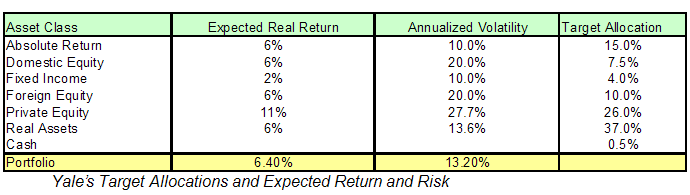
Yale identifies six major asset classes and provides expected rates of return and risk estimates for each. These values, along with the target allocation to each in Yale’s portfolio are shown below:

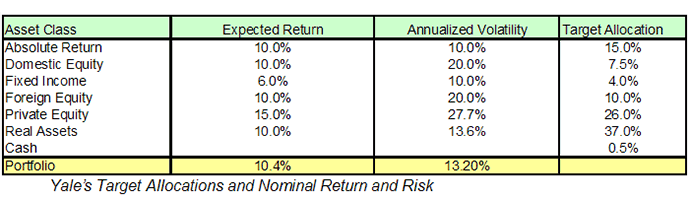
Yale states that it uses a rate of inflation that is 1% per year greater than the CPI to reflect the higher rate of inflation in higher education, so we can then estimate the expected total return from these asset classes if we assume a 4% base inflation rate (3% for CPI + 1% additional).
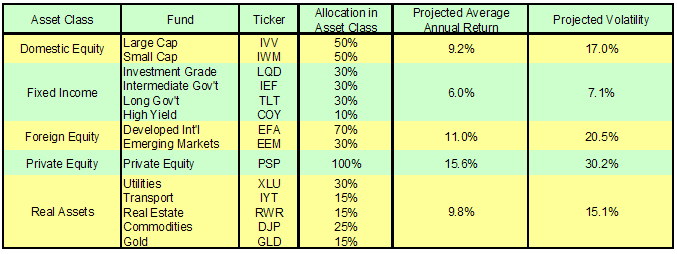
To assess the reasonableness of the projected risks and returns for the various asset classes, I created a series of proxies using ETFs. I then ran these proxies through my Monte Carlo simulation to generate estimates for the risks and returns for the various asset classes (see table below).
Monte Carlo Projections for Yale’s Asset Classes
Overall, the projected risks and returns for the various asset classes from my Monte Carlo simulation agree closely with Yale’s projections.
In the case of private equity, I used PSP, a fund designed to track an index of public private equity firms. The real asset component of the portfolio is somewhat harder to approximate. I have created the real asset sub-portfolio by combining utilities, transport stocks, REIT’s, commodities, and physical gold.
The hardest component of Yale’s projections to reasonably approximate is the Absolute Return (AR) component. While there are funds with this designation, the performance of this ‘asset class’ is so dependent on manager skill that it is inappropriate to rely on them as a proxy for AR performance. AR strategies are supposed to be market-neutral, with near-zero beta. By allocating the 15% that is supposed to go to AR to a short-term bond fund as a conservative proxy, my Monte Carlo projections give this portfolio a projected return of 10% with a volatility of 16.2% (using data through March 2010). If I allocate the 15% targeted to AR to investment-grade corporate bonds (using the LQD ETF), the projected return is 10.5% with volatility of 17%. This seems like a better fit for AR, at least in terms of risk level and impact on the portfolio, because LQD has projected volatility of 9.1% – quite close to the 10% projected by Yale for AR.
Overall, the projected return and risk for our representative portfolio – 10.5% and 17%. respectively – are quite similar to the Yale’s projected return and risk of 10.4% and 13.2%, especially given the challenges in creating a reasonable proxy. A more critical selection of individual investments can certainly add return relative to the market-cap weighted indexes that we have assumed. Further, we have ignored the potential value that active management could add. My own research suggests that it is plausible that an absolute return strategy could generate 10% in return with 10% in annualized volatility (as Yale projects for the AR component of the portfolio). In fact, I have found that this appears to be a fair estimate of what is possible.
Overall, then, our Monte Carlo simulations are broadly in agreement with Yale’s projections, justifying Yale’s estimates of various asset class returns. Our estimates of the portfolio risk and return using index-based asset classes result in a similar projected return, albeit with higher risk than Yale’s estimates. Yale uses derivative instruments to manage risk, and some of the additional return that they expect to receive from their AR strategies could fund the purchase of risk-reducing options and swaps in their portfolio, bringing the risk levels of Yale’s and our Monte Carlo simulations closer into alignment.
Could the magnitude of potential loss in 2008-9 have been anticipated?
One of the largest questions on peoples’ minds with regard to the endowment model is whether the substantial losses in FY 2009 indicate flaws in the underlying model. The almost 25% loss in Yale’s endowment was a shock. Yale’s 2008 report states that the expected real return of the portfolio is 6.4%, which translates to 10.4% in nominal return. The projected risk level was 12.7% in annualized volatility. If we run our Monte Carlo simulation using data through June of 2008 for the proxy portfolio that we created for Yale, we get an expected return of 9.3% with annualized volatility of 11.7%. Note that this is still assuming that Absolute Return is approximated by investment-grade bonds. Based on these estimates, what is the worst than can happen?
The S&P500 lost approximately 26% for the year ending June 2009, so the losses in Yale’s endowment were on track with the market. The risk level that Yale projected for their overall portfolio was 12.7%, however, which is far less volatile than the 20% risk level that they estimated for domestic equities. The losses in FY 2009 to Yale’s portfolio were much more severe relative to their expected risk level than were the losses from domestic equities.
The answer to the question posed at the start of this section, then, is somewhat nuanced. The level of loss suffered by Yale’s portfolio was within the estimated realm of possibility, although it was somewhat higher than was predicted by Yale’s estimate of risk for its portfolio. This situation contrasts starkly, for example, with the events that famously destroyed Long Term Capital Management, which had been estimated as absolutely impossible over the multiple lifetimes of the universe.
What can we conclude?
While FY 2009 was a painful one for Yale, its 20-year annualized return of 13.4% is remarkable. One bad year is insufficient evidence to discount the conceptual framework developed by Swensen and his team. The Yale model combines portfolio theory with a focus on selecting active managers who will add value. While I cannot judge the active component of Yale’s strategy, I can offer some broad observations.
First and foremost, Yale has consistently stated that the vast majority of its assets are invested in asset classes with risk and return properties consistent with equities, resulting in an overall allocation that is not low-volatility. With only 4% of the target asset allocation in bonds, it cannot be surprising that this portfolio lost almost as much as the S&P500 in FY 2009.
For individual investors and advisors, one take-away is that diversification works to increase risk-adjusted returns over long periods, but it does not provide much protection during severe market dislocations. This conclusion applies to all portfolios, not just Yale’s.
My analysis of the risk exposure in Yale’s portfolio suggests that its true risk is higher than Yale’s estimates, but I do not have the details of the Yale holdings. The risk in my synthetic portfolio could be reduced by carefully selecting low-correlation components and hedging with derivatives, bringing its risk closer to that of Yale’s.
In my analysis, I have not explicitly accounted for the relative impact of illiquidity on portfolio performance. With an additional source of alpha (via adding illiquid assets), we could easily end up with the same expected returns, but lower total portfolio risk, and we could match Yale’s projections even more closely.
Research by Roger Ibbotson suggests that an investment strategy that targets illiquid public securities has historically generated a high level of alpha (greater than 5% per year). Investors and advisors who wish to follow Yale’s approach of trying to increase portfolio returns by taking on liquidity risk may do so using relatively illiquid (but public) securities. Illiquid public securities also tend to have high levels of non-market (i.e., non-systematic) risk. In fact, this research suggests that non-systematic risk is the key driver of surplus return and that the illiquidity is secondary. To build a sub-portfolio with elevated levels of non-systematic risk, one could combine low-beta, low-R-squared stocks. These stocks naturally tend to have higher proportions of non-systematic risk, lower liquidity, and have historically reaped premium returns. We will explore model portfolios that exploit these effects in a future article.
Implications for advisors and investors
The endowment model (as practiced by Yale) makes sense when viewed through the lens of our Monte Carlo simulations. Its FY 2009 returns were within reasonable estimates of probability. The emphasis on alternative asset classes in Yale’s portfolio means that even comparing the returns from the S&P500 to the endowment portfolio is somewhat suspect. Perhaps Yale placed too much faith in the lack of correlation between its portfolio and the movements of the broader capital markets, but the overall logic behind Yale’s model is perfectly sound, even in light of FY 2009.
Swensen remains a staunch advocate of the principles of portfolio management that we have laid out in this discussion. The long-term record of Yale’s endowment, combined with the approach’s consistency with financial theory, validates his position.
The lessons for advisors and individual investors who wish to gain some of the advantages of the endowment model are:
- Bet on the equity risk premium
- Diversify far beyond stock and bond indexes
- Exploit low-liquidity asset classes where appropriate
- Neither (2) nor (3) will necessarily provide protection in a market crisis
These conclusions do not mean that one should invest in private equity, venture capital or hedge funds, however. Swensen makes it clear that Yale’s advantages in these areas stem largely from the ability to uniquely align incentives with managers, a capability that individuals do not have, as well as his expertise and the extensive resources available to him to select and monitor Yale’s managers. Fortunately, there are other ways for us to exploit the benefits available from real assets and from relatively illiquid investments.
Quantext Portfolio Planner is a portfolio management tool. Extensive case studies, as well as access to a free extended trial, are available at http://www.quantext.com
Quantext is a strategic adviser to FOLIOfn,Inc. (www.foliofn.com), an innovative brokerage firm specializing in offering and trading portfolios for advisors and individual investors.
Read more articles by Geoff Considine, Ph.D.