Nassim Taleb and Zvi Bodie are among those who advocate a wealth management strategy that includes options. Despite their evangelism, though, options are rarely a part of retirement portfolios.
The risk-limiting properties of options will be increasingly valuable as investors react to the amplified volatility of the last two years. The costless collar, a straightforward options strategy, gives investors the upside of an asset class (such as equities) while absolutely limiting the downside risk.
Costless collars are created by selling call options against a security or an index, and using the proceeds to purchase an equivalent amount of put options. The costs of the option transactions offset one another, and establish a maximum return and minimum loss for the asset.
My research suggests a growing role for options in wealth management, and collars in particular will have considerable appeal to investors. Among its practitioners is the $2.8 billion Gateway Fund (GATEX), which uses collars as part of a tactical asset allocation strategy. A recent startup fund, the Collar Fund (COLLX), applies this strategy in a more mechanical fashion and provides a good illustration of the value costless collars offer.
Let’s explore the research behind costless collars, how well they work under today’s market conditions, and their appropriate role in a wealth management strategy.
Research confirms the value of the collar strategy
Academic research supports the idea that a costless collar can enhance the risk-adjusted returns of a portfolio. A 2008 article by Louis D’Antonio, Equity Collars as an Alternative to Asset Allocation, looked at how a mechanical strategy of repeatedly executing rolling costless collars with a one-year period to expiration for the S&P500 would have altered the risk and return of a portfolio versus a straightforward investment in the S&P500 for the period from 1926-2005. The collar structure sells a call with a strike that is 20% above the current level of the S&P500 and buys a put with a strike that is 10% below the current level of the S&P500. The portfolio receives the first 20% in annual gains and is protected against any losses beyond -10% over each one-year period. I will discuss the reasonableness of the assumptions underlying this strategy shortly.
If such a collar could be executed, what would happen? The average (arithmetic) annual return of the S&P500 over the 79-year period was 12.3% with a standard deviation of 20.2%. The average annual return of the collar strategy was 8.9% with a standard deviation of 12.1%.
Unsurprisingly, the collar strategy lowered both risk and return.
As a direct benchmark, the analysis also shows that a portfolio that is made up of 52% S&P500 and 48% five-year Treasury bonds had an average return of 8.8% with a standard deviation of 10.9%, almost identical in average return to the collar strategy, but with less risk. The big difference between the collar and the 52/48 portfolio was in the extreme downside. The worst one-year return for the collar strategy over the period was -10%, as compared to -23.7% for the 52 /48 portfolio. If the standard deviations are the same, but the probabilities of extreme events are higher, this suggests that the simple stock/bond portfolio has much higher kurtosis (i.e. fatter tails) than the collar portfolio and this is exactly what the author found. Extreme upside deviations further confirmed that the collar portfolio had lower kurtosis.
Exploring costless collars with Monte Carlo simulation
To further illustrate these concepts, I looked at three alternative portfolios using Monte Carlo Simulation (Quantext Portfolio Planner, in this case):
- 100% investment in S&P500 ETF (SPY)
- 50% investment in SPY and 50% investment in bond ETF (AGG)
- Investment in SPY with costless collar executed on SPY
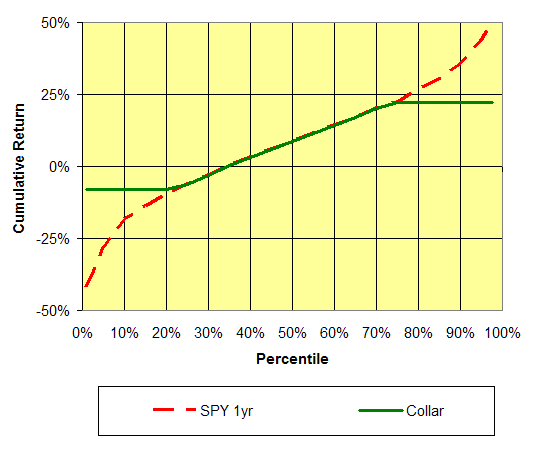
I simulated returns for a one-year time horizon for an S&P500 ETF (SPY) and for a bond ETF (AGG). From there it is simple to model the costless collar portfolio. The probabilities of the range of possible returns for a one-year time horizon are summarized in the chart below (a percentile chart).

The horizontal axis shows the percentile of the outcome and the vertical axis show each possible outcome. The 10th percentile return for the S&P500 (SPY) is a return of -19%; there is a projected 10% chance that the S&P500 will lose 19% or more over the next twelve months. The projected 1% tail for the S&P500 is -44%, and the worst one-year return for the S&P500 in the period from 1926-2005 reported by D’Antonio is -43.4%. The Monte Carlo results account for the fact that the holder of the collar receives the dividends from the position in SPY.
The lower percentiles for the collar strategy are flat – we cannot have a one-year return worse than -10% because this is where the put options kick in. The high percentiles are similarly truncated due to the call that we sold in creating the collar. We get all the gains on the S&P500 up to 20%, but no more. Between where the put and call kick in, we will track the S&P500. If the S&P500 ends up anywhere between -10% and +20% for the year, our returns with the collar strategy will be indistinguishable from the S&P500 – and that is easily seen on the chart above. The impacts of extreme events (good and bad) have been removed from the portfolio.
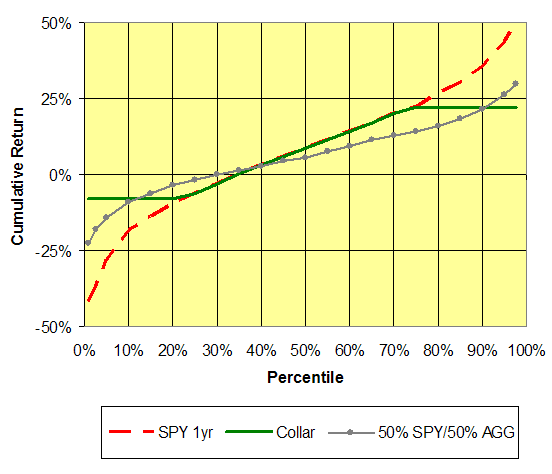
The following graph shows the returns for a portfolio that is 50% invested in SPY and 50% invested in AGG, overlaid on the previous chart.
The collar portfolio and the 50% SPY/50% AGG portfolios have the same standard deviation of returns, but the other components of risk in these two strategies are quite different. The standard deviation measures of the average size of swings in a portfolio, but tells you nothing about the shape of the distribution of portfolio returns. If returns are normally distributed (which D’Antonio verified for the one-year returns on the S&P500), the returns for the collar strategy are normally distributed with the extreme tails cut off – the distribution is more square-shaped. In statistical terms, the kurtosis is much lower for the collar. (For statistically-schooled readers, you will recognize that the standard deviation is one moment of the distribution. The collar changes the other moments – especially the kurtosis, which is a measure of the ‘fatness’ of the tails of the distribution.)
Once you layer options into the portfolio, simply looking at the average return and the standard deviation of returns no longer tells the full story – you have to look at the tails. If things get really bad in the equity markets, you can lose considerably more with the 50/50 SPY/AGG portfolio than with the collar. With the 50/50 portfolio, the projected 1% tail is -22% – more than twice the maximum loss with the collar strategy, even though both strategies have almost identical standard deviations.
Why would an investor prefer the 50/50 portfolio vs. the collar portfolio? Given all of the uncertainties in estimating risk and return, let’s assume the expected returns of both of the strategies are the same. The collar is more sensitive to movements in the S&P500 than the 50/50 portfolio, as long as the S&P500 stays within -10% and +20%. If the S&P500 returns -8%, the collar will also return -8%, but the 50/50 portfolio will tend to do better because the 50% in bonds will temper the loss in equities. The collar is preferable if the market moves down dramatically (the collar wins at the 10th percentile), but the 50/50 portfolio, by keeping the upside in equities, outperforms at the 90th percentile and above.
Great in theory, but will it work today?
The analysis by D’Antonio assumes that you can sell a call option with a strike price that is 20% above the price of the S&P500 and use the proceeds to buy a put option with a strike price that is 10% below the price of the S&P500 on a consistent basis. As of this writing (Dec 21, 2009), SPY is trading at $111.48 per share. The strike price of the call would be $133.8 if it were exactly 20% above this price. The Dec 2010 call option with a $135 strike is trading at about $1.55. The strike price for a put option that is 10% below the current price of SPY would be $100.33. The Dec 2010 put option with a strike of $100 is selling at about $6.70.
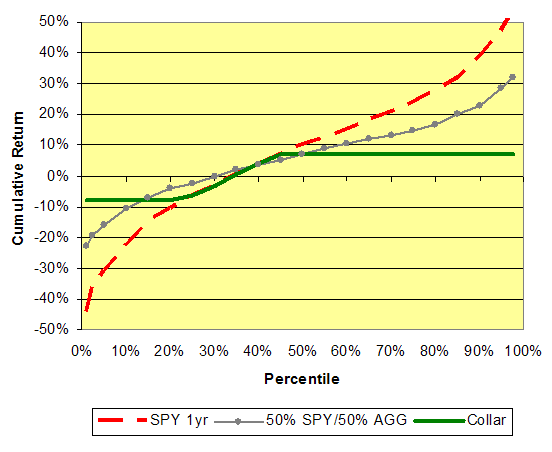
We could not put the strategy into effect – the puts are far too expensive. To do a costless collar with put options with a strike at $100, we would need to sell calls with a strike at $117 because these are selling at about $6.90, the closest price to the $6.70 per share we would need to pay for the put options. Selling the $117 call option to purchase the protective put gives us a lot less potential upside return than if calls could be sold with a strike of $135. The $117 calls give us a potential gain of only 5% before the call options go into the money.
The $135 call option has an implied volatility of 18% while the $100 put option has implied volatility of 26% (see here). The put options, adjusted for the difference in strike prices, are disproportionately expensive relative to the call options. In light of recent market declines, this is not surprising.
The asymmetry in implied volatility between the puts and calls illustrates the pattern of risk aversion in the market.
We can keep all the return on the S&P500 up to a 5% gain, plus the dividend yield (2.1%) for a total potential gain of 7.1% if the market rises. If the market goes down, we can lose no more than 10% from a drop in price, but we still get the 2.1% yield so we will lose no more than 7.9%. The median payout for this collar is estimated to be on the order of 7% – very close to the maximum possible payout from the collared position – but the average payout is approximately 1.6%. These Monte Carlo projections are all highly approximate, of course, but the asymmetry between the call and put prices is very concrete: the calls are currently cheap relative to puts for the S&P500.
The degree to which call options and put options are inconsistently priced might be due to two factors. One of these is the volatility ‘smirk,’ which is the increase in implied volatility as the strike price goes further below the current price. In general, this effect applies to strike prices above the current price (the volatility smile), but the effect tends to be asymmetric, with considerably larger increases in volatility for strike prices well below the current price.
The second factor would be a breakdown in the relationship between put prices and call prices (in technical terms this would be a violation of put-call parity). This is easily explored.
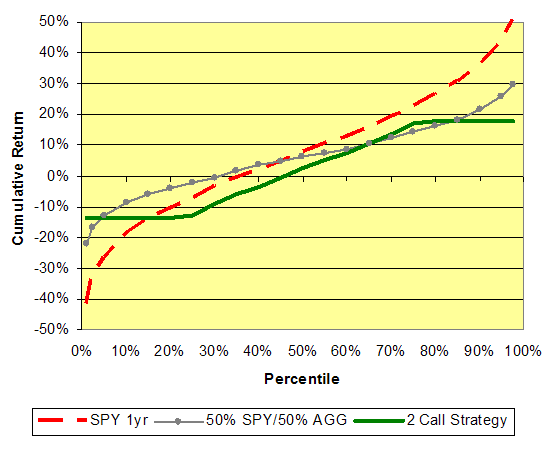
A costless collar on the SPY with a +20% and -10% band can be almost exactly replicated if we buy a call option on SPY with a strike of $100 and sell a call option on SPY with a strike of $135, with both having the Dec 2010 expiration date. The current price of the Dec 2010 $135 call option is $1.50 and the current price of the Dec 2010 $100 call option is $16.50. If you buy the $100 call and sell the $135 call (call it the Two-Call Strategy), the net position is just like buying SPY and then executing the covered call:
Because of the volatility smirk, replicating the strategy using only call options is not very attractive because we end up paying too much for the $100 call. This result suggests that it is the volatility smirk that is making costless collars relatively unattractive at current prices, rather than a violation of put-call parity.
The implied volatility for options with strike prices well below the current level of the market is quite high (we are concerned mainly with puts, of course) – which means that costless collars require that we give up a lot of upside to get protection from large downward market moves. Again, this is not surprising given the recent market declines and recent periods of very high volatility. Investors are far more concerned about the potential for large losses than they are optimistic about the potential for large gains. This is not a permanent situation, but illustrates how the relative attractiveness of the costless collar may evolve over time.
Some real-life data
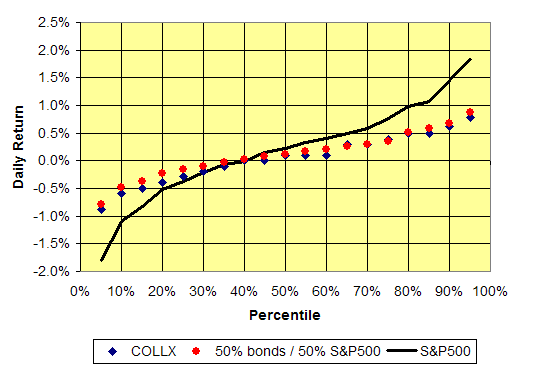
As mentioned earlier, there is a mutual fund that is intended to implement costless collars as a mechanical strategy (COLLX). This fund has less than one year of history. It is interesting, however, to compare the daily returns from COLLX since its launch in mid-2009 to the S&P500 and to a 50/50 portfolio (see graph below).
The range of performance of COLLX since launch looks remarkably like a 50/50 portfolio, and we do not see the “floor” and “ceiling” effects that would be expected based on the idealized results of costless collars shown in the Monte Carlo simulations. This is due to the fact that this fund can invest in a range of stocks and ETFs and can purchase collars at a range of strikes.
The idea of implementing costless collars on a range of individual holdings has additional implications that are beyond the scope of this discussion.
Final thoughts
The most attractive element of collar strategies is their ability to remove the impact of really bad events on a portfolio with the purchase of a put option. The ability to finance the purchase of the puts by selling off some of the upside potential from the portfolio is appealing, and avoids having to sell existing holdings and retains the dividends as a stream of income.
The potential payout depends on the actual prices at which the puts and calls can be executed. In the current market, the price that we can get for the calls is low relative to the price that we must pay for the puts. This is not a reflection of a disconnect between call prices and put prices – we see the same effect if we create a synthetic position that matches the costless collar using two call options. The challenge in making the costless collar attractive is a direct result of the volatility smirk: people are currently willing to pay a lot for downside protection.
Current market conditions provide just one example of when a costless collar will look less attractive. Even at current prices, a costless collar will look attractive for some investor due, for example, to tax issues associated with selling current holdings. Furthermore, we have examined the case for the collar applied to the S&P500. With other indices or portfolios, the current prices of options may be more attractive.
For income-oriented investors who are concerned about hedging near-term downside potential, the very limited upside available at current options prices may not be too great a concern. Even at current prices, a costless collar strategy applied to a portfolio of high-yield stocks can be quite attractive. With stocks like Verizon (VZ) and Con Ed (ED) having dividend yields at 5.7% and 5.1% (respectively), locking in the dividend with a collar looks quite attractive, and the relative balance of upside given up to get the downside protection is less of a concern. ED is at about $46 as of this writing. The January 2011 $45 call option on ED is at about $2.80 and the $40 put option is at about $1.80. If you sell the calls and buy the puts, you keep $1 per share in net premium, but that is offset by the fact that the call option is about $1 ‘in the money’ – the call has a strike of $45 and the current price is $46. This position won’t make anyone rich, but it does allow an investor in ED to cushion the potential downside of a big decline.
Potential investors must understand that the use of a costless collar strategy has a complex impact on the portfolio. Simply looking at the change in expected return and standard deviation in returns is insufficient, because the portfolio may no longer have normally distributed returns on any specific time scale.
After a two-year period in which the market has reminded us that a 40% decline in a year is a real possibility, the ability to shape portfolio returns to create a floor on absolute losses is very attractive. Particularly for retirement planning, the potential increase in happiness that a windfall could provide is far less significant than the potential for misery from a large loss.
Geoff Considine is the founder of Quantext (www.quantext.com) a firm which sells Monte Carlo – based portfolio management software. Geoff has recently published an e-book on the use of options in wealth management.
Quantext is a strategic adviser to FOLIOfn,Inc. (www.foliofn.com), an innovative brokerage firm specializing in offering and trading portfolios for advisors and individual investors.
Read more articles by Geoff Considine