Advisor Perspectives welcomes guest contributions. The views presented here do not necessarily represent those of Advisor Perspectives.

“I am trying to figure out what it means to be long-term in a world with extreme short-term volatility and the potential for seismic change in the next few years.”
~ Anonymous Private Investor
When faced with change, investors often struggle to know how to react – are the new circumstances welcome relief, or do they pose a threat? For most investors, the past twelve months have been a grueling test of their ability to respond to changing markets, changing risks, and – perhaps most frightening – changing “investment truths.”
As our data show, many wealthy investors have responded by increasing their use of tactical asset allocation and positioning their portfolios to defend against liquidity, concentration and inflation risk. As many have adapted and formed fresh perspectives on risk, advisor relationships, and investing in general, an enduring lesson has emerged: change is the only constant.
Our organization, the Institute for Private Investors (IPI), was founded in 1991 as an educational and networking resource for families with substantial assets and their advisors. Today, we count 1,100 individual private investors among IPI’s members, 80% of whom oversee in excess of $50 million. We survey members quarterly to ascertain their views of the capital markets, their perceptions of risk, and their asset allocations.
Investors grapple with risk
Three quarters of the members who responded to our November 2009 survey1 said they have changed the way they view and manage risk in their portfolio since 2008.
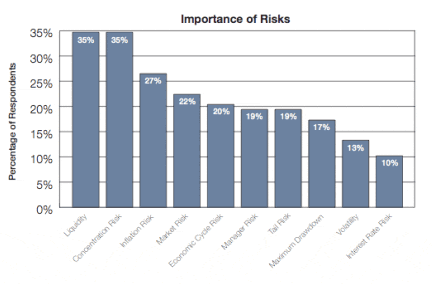
Two years ago,2 when asked about the risks that concerned them, IPI members cited manager risk as the single most important risk they needed to monitor. At the time, members viewed interest rate risk and inflation risk as the two least important risks. But now members list liquidity and concentration risk as top concerns, with 35% of respondents describing them as “extremely important.” Inflation risk has also returned to the fore – 27% of respondents called it “extremely important.” Investors may be viewing risk in a different light, but what metrics will they use to monitor and manage these risks? Volatility is the traditional risk metric used in the industry, but IPI members now list it among the least worrisome risks.
Tactical asset allocation gains ground
The financial crisis altered other views as well. Of the 62% of respondents who reported having a formal, written investment policy in the spring of 2009,3 over half said that they were making, or considering making, changes to their policy in light of their 2008 experience.
In 2008, IPI members cushioned the fall with cash, reporting an all-time-high average allocation to cash of 16.7%,4 nearly double their allocation in 2007 (8.6%).5 Not surprisingly, members who had a higher percentage of their portfolio allocated to cash in 2008 fared better than their peers. On average, those with 41% or more in cash returned -13.80% compared to -18.72% for those with less than 10% in cash and -28.86% for the eight investors who had 0% in cash. Perhaps this experience emboldened members to change their investment policy to allow for more tactical asset allocation.
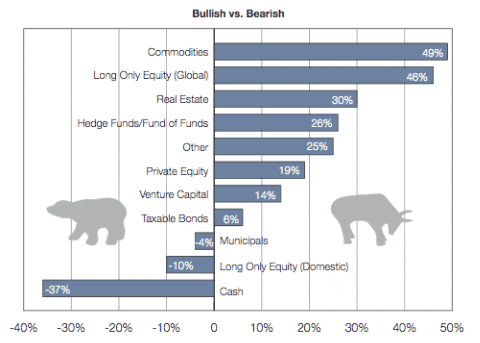
More allocation adjustments ensued at the end of 2009,6 and the chart below shows the overall bullish vs. bearish sentiments of IPI investor members based on survey results obtained in November 2009. The figures in the chart represent IPI investors’ net sentiments: we subtracted the percentage of respondents who intend to reduce their allocation to an asset class from the percentage who plan to increase their allocation. Cash, for example, has a net value of -37%, because 17% plan to increase and 54% plan to decrease their cash holdings.
1 IPI survey, “Fight-or-Flight (or Freeze)” (May 2009).
2 IPI survey, “Family Performance Tracking® Survey 2008” (March 2009).
3 IPI survey, “Family Performance Tracking® Survey 2007” (June 2008).
4 IPI survey, “Change Is The Only Constant” (December 2009).
5 IPI survey, “New Thinking” (November 2009).
6 IPI survey, “Absolute Risk and Relative Return” (January 2007).